
By - Sabine Wetzel - JRS Pharma
This article discusses the effectiveness of alginates, which are naturally occurring salts found in brown algae, for use in anti-reflux formulations.
Reflux of gastric acid into the esophagus is a common problem that may lead to heartburn, symptoms of which can include a sour or bitter taste in the back of the throat and mouth and a burning pain in the esophagus that can radiate into the chest, reminiscent of a cardiac event [1]. In chronic cases, reflux can lead to more severe conditions, such as the gastroesophageal reflux disease (GERD), which affects up to 30 percent of adults in the western world [2]. Long-term reflux of gastric juice can damage the mucous membrane of the esophagus, leading to inflammation, preliminary stages of cancer (Barrett’s esophagus), ulcers, bleeding, and esophagus strictures due to scarred tissue. The prevalence of acid reflux, as well as its short- and long-term health consequences, make it necessary to formulate effective drug products.
Physiological Background
Gastric juice mainly contains water, hydrochloric acid, pepsinogen, mucus, and bicarbonate. These components break down, denature, and disinfect ingested food. Due to its hydrochloric acid content, the pH of gastric juice under fasted conditions lies in the range of 1 to 1.5 [3].
In healthy people, the lower esophageal sphincter muscle prevents the reflux of acidic gastric content into the esophagus. However, certain functional disorders may lead this closure mechanism to fail. Organic causes as well as nutritional and lifestyle habits—such as excessive consumption of alcohol, nicotine, or caffeine; severe obesity; and psychological stress—can trigger or aggravate reflux-related health issues [1, 4, 5].
Medical treatments
The acidity of gastric fluid can be reduced by pro- ton-pump inhibitors (PPls), such as lansoprazole, omeprazole, and esomeprazole, or by administration of mild basic substances. The latter have a very rapid, but short-term action. In fact, the strong reduction in stomach acidity often leads to a rebound effect, which aggravates the situation. PPls, on the other hand, enable a mild, long-term adjustment of the gastric fluid’s pH, making them a popular choice for chronic acid reflux sufferers. There is, however, increasing concern about the possible side effects of PPls, including an increased risk of gastric neoplasia, kidney disease, bone fractures, impaired absorption of micronutrients, dementia, and liver disease [6].
Alginate-based anti-reflux preparations, by contrast, work by forming a protective layer in the stomach that acts as a mechanical barrier, preventing reflux into the esophagus. Alginates are salts of naturally occurring alginic acid, a major structural component in the cell walls of brown algae. After extracting alginic acid from seaweed, sodium or cal- cium chloride is added to precipitate the alginate salt [7].
While sodium alginate is water-soluble, calcium alginate and alginic acid form gels in water. These gels form a pro- tective layer, or raft, in the stomach, which floats on the surface of the gastric fluid and prevents reflux of gastric acid into the esophagus, as shown in Figure 1. Flotation is achieved when carbon dioxide bubbles embed into the gel layer. Both alginic acid and calcium alginate are able to form protective rafts (Figures 2, 3).
Over-the-counter medicines containing alginates have been used for the symptomatic treatment of heartburn for more than 50 years and have a positive track record in terms of efficacy and safety [8].
Effect of calcium on gel-raft strength
Calcium-induced cross-linking is known to have a strengthening effect on alginate gels [6, 7]. To understand the influence of calcium on the robustness of the formed raft, researchers carried out a study comparing the raft strengths for three different anti-reflux formulations based on sodium alginate (Vivapharm PH R5, JRS Pharma). Formulation 1 contained no calcium, using only sodium carbonate as the source of CO2. Formulation 2 contained calcium in a concentration commonly found in commercial alginate-based anti-reflux products. Formulation 3 contained twice the regular amount of calcium. Table 1 shows the basic outline of a corresponding formulation. The appearance of the resulting rafts in 0.1 M hydrochloric acid is shown in Photo 1.
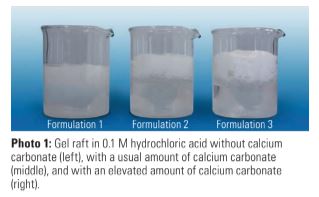
The formulation without calcium produced the thinnest and weakest gel raft layers, as shown in Figure 4. Formulation 3, containing an elevated amount of calcium carbonate, developed the thickest gel raft. However, when compared to Formulation 2, Formulation 3 showed a lower raft strength. This may be a result of the inclusion of more and larger gas bubbles into the raft, reducing its overall robustness.
As demonstrated by these results, raft strength and thickness are affected by the concentration of calcium carbonate. Careful balancing of the calcium-induced gelling and the carbonate-related gas formation is required during formulation development.
References
- Clarrett, D.: Gastroesophageal Reflux Disease (GERD), Missouri Medicine, 115 (3), 214-218 (2018).
- Ness-Jensen, E. et al.: Lifestyle Intervention in Gastroesophageal Reflux Disease, Clinical Gastroenterology and Hepatology, 14 (2), 175-182 (2016).
- https://flexikon.doccheck.com/de/Magensaft
- Marburger, A.: Alginate und Carrageenane - Eigen- schaften, Gewinnung und Anwendungen in Schule und Hochschule, PhilippsUniversitat Marburg (2003).
- Badillo, R. and Francis, D.: Diagnosis and treatment of gastroesophageal reflux disease, World Journal of Gastrointestinal Pharmacology and Therapeutics, 5 (3), 105-112 (2014).
- Fossmark, R. et al.: Adverse Effects of Proton Pump Inhibitors-Evidence and Plausibility, International Journal of Molecular Sciences, 20 (20), (2019).
- Kuen, Y.L. and Mooney, D.J.: Alginate: properties and biomedical applications, Progress in Polymer Science, Sci. 37(1): 106–126 (2012).
- Mandel, K. G. et al.: Review Article: Alginate-Raft Formulations in the Treatment of Heartburn and Acid Reflux, Alimentary Pharmacology & Therapeutics, 14 (6), 669- 690 (2000).
Sabine Wetzel is an application scientist at JRS Pharma (info@jrspharma.com, www.jrspharma.com).