
By - Beverly Schad and Jen Gornet - Particle Dynamics
Microencapsulation is a useful method for protecting and preventing the degradation of active ingredients in pharmaceutical and nutraceutical solid dosage formulations. This article explores the benefits of lipid microencapsulation, which include increased bioavailability, reduced unwanted interactions, taste and odor masking, prevention of color migration, and improved stability.
Solid dosage form developers are always searching for ways to decrease interactions of pharmaceutical and nutraceutical active ingredients to minimize processing and degradation risks while improving product quality, bioavailability, and stability. Also, to meet accelerating market needs, developers of new products are increasingly prioritizing speed to market. Microencapsulation of actives can be an effective means of achieving these goals.
Microencapsulation involves the co-processing of one or more actives within a matrix that forms a barrier and protects the actives from unwanted interactions or degradation and/or improves the actives’ qualities and properties within a formulation. According to a 2020 report released by Globe News- wire, the microencapsulation market is expected to grow at a 12.9 percent compound annual growth rate from 2020 to 2025, driven by demand for taste masking and enhanced shelf life, with added values in personal care products [1].
The barrier matrix protecting the active in a microencapsulation process can be either polymer-based or lipid-based. Polymer-based microencapsulation encapsulates actives through a coating process. The coating typically consists of an aqueous polymer dispersion that is atomized and sprayed onto the active ingredient particles in a fluid-bed process. The water evaporates from the fluidized bed, leaving the active particles evenly encapsulated within a polymeric coating. The microencapsulation process can use various polymers, such as celluloses and alginates, to coat the active.
Lipid-based microencapsulation involves encapsulating one or more actives within a lipid matrix to create spherical lipid-active microparticles with a consistent shape and size. Lipids are fatty acids and derivatives of fatty acids and include four different classifications:
- Triglycerides from fats and oils (either from saturated or unsaturated fatty acids) that are insoluble in water. Examples include stearic acid, oleic acid, and palmitic acid.
- Phospholipids, which consist of both hydrophilic and hydrophobic regions of the fatty acid. Only two fatty acid molecules are attached to the glycerol, while the third glycerol binding occurs at the phosphate group. Phospholipids can thus immerse and orient into the hydrophobic region of the cell membrane easily.
- Steroids are complex compounds that do not contain fatty acid properties but are classified as lipid based because they have lipid-like properties, with four fused carbon rings. Waxes, such as carnauba and beeswax, are nonglyceride lipids consisting of one hydroxyl group. Waxes consist of esters of fatty acids and have barrier properties that prevent moisture migration.
- Lipoprotein lipids are complex, consisting of a triglyceride and a cholesterol center, which is then surrounded by a phospholipid shell. The structure of the outer matrix is hydrophilic, while the inner matrix is lipophilic, therefore drawing a hydrophobic active inward and stabilizing the active.
Lipid microencapsulation allows developers to create stable, scalable formulations for poorly soluble and complex actives. Lipid microencapsulation provides the following advantages:
- Creates a barrier to prevent interactions with other components and environmental conditions and enhance stability;
- Increases bioavailability;
- Masks unpleasant tastes and smells;
- Sustains potency, increasing product shelf life and consumer repeat use;
- Prevents color migration and transfer;
- Sustains flavor profile;
- Creates small particles, which increases the palatability of chewable tablets;
- Uniformly distributes active in the lipid matrix; and
- Creates a free-flowing powder, which promotes easy mixing.
Lipid microencapsulation process
Lipid microencapsulation forms lipid-active microparticles by co-processing the active(s) with the heated lipid using one of several techniques, including spray congealing (commonly referred to as spray cooling or spray chilling), hot-melt extrusion, and spinning-disk congealing.
With spray congealing, the active is first suspended in a melted lipid such as a wax. The suspension is then atomized into a cooling chamber, where turbulent, cool air solidifies the droplets into microparticles. Spray congealing is sometimes considered to be a hybrid between spray drying and hot-melt extrusion [2].
With hot-melt extrusion (HME), the active and polymers are fed into a twin-screw extruder. The extruder uses heat and pressure to melt the lipid and blend it with the action at the molecular level. The machine’s parallel rotating screws then force the blend through a narrow orifice at the extruder’s discharge. The active-lipid blend cools as it passes through the orifice, discharging as a solid ribbon, which can then be cooled, cut, and sized.
With spinning-disk congealing, the active is uniformly suspended in a melted lipid, then the suspension is dispensed onto a spinning disk. The suspension flows from the center of the spinning disk to the perimeter and forms micron-sized droplets as it becomes airborne at the disk’s edge. As the micron-sized droplets cool, the lipid matrix solidifies, forming spherical free-flowing microparticles containing the active. The disk’s rotational speed determines the particle size. The micron particle size increases the palatability of chewable tablets without grittiness in the oral cavity.
Each of these techniques creates solidified microparticles, whose immobilized state creates a lipid barrier that protects the active from the surrounding- ing environment, promoting stability and preventing product degradation. Since the matrix is lipid-based, there is no moisture or hydrophilic interface. The lipid covers the active, serving as a barrier, which decreases the propensity of the active to react with other formulation ingredients and promotes stability.
Increasing bioavailability
According to a 2020 Catalent survey of more than 200 scientific researchers, lipid formulations are the primary technology that researchers are currently working on for early clinical trials and provide optimal bioavailability enhancement for poorly soluble actives [3]. Lipids are important for improving the bioavailability of poorly soluble actives.
Lipids are an integral part of the human anatomy, as they are the main components of cellular membranes [4]. The lipid bilayer of cell membranes is made of intracellular and extracellular components that control the passage of substances entering and exiting the cell membrane [5]. Therefore, when poorly soluble actives are formulated through lipid microencapsulation, the lipid bilayer of the cellular membrane facilitates solubilization of the lipid microencapsulated particles [6]. The solubilized phases impact the absorption of actives, increasing dissolution of the lipid and bioavailability of the active in the intracellular and extracellular digestion process.
Taste masking and flavor additives
The suppression of bitter tastes in oral dosage forms is important for patient compliance. The dislike of bitter-tasting vitamins and medications, especially among young children, may lead to suboptimal treatment [7]. Bitterness, astringency, chalkiness, and metallic tastes can be suppressed using masking agents, sweeteners, and flavorants. Embedding these masking agents, sweeteners, and flavorants into the lipid-active matrix masks bitter-tasting actives and makes the product more palatable, which can increase patient compliance.
Lipid-based microencapsulation enhances taste-masking because of the characteristics of the lipids, masking agents, and flavorants used [6]. Lipid formulations that use saturated long-chained biocompatible fatty acids have a neutral taste. Also, fatty acids do not hydrolyze in the oral cavity, allowing the active to be masked effectively by flavorants and sweeteners added to the lipid formulation.
Oil-based flavors are excellent for flavoring lipid-based microencapsulated products. The oil-based flavor is soluble in lipid bases, affording a smooth flavor profile capturing the flavor essence. Oil-based flavors are encapsulated within the lipid microencapsulation matrix, so the flavor profile is sustained over time. The resulting product provides desirable organoleptic properties as well as tastes consumers enjoy and trust.
Maintaining potency and preventing color migration
Lipid microencapsulation can also effectively maintain potency, prevent color migration, and block unpleasant odors in dietary supplement products. Common nutrients that lose potency over time include folic acid and vitamin B12, which can lose up to 10 percent of their potency after six months, and vitamin A, which can lose 40 percent of its potency after six months [8].
Moreover, some vitamins can stain the oral cavity. For example, vitamin B2 from riboflavin transfers a yellow color, and iron vitamins from ferrous fumarate, ferrous sulfate, and polysaccharide iron complex transfer a black or brown color. Lipid microencapsulation prevents such color staining.
Examples of lipid microencapsulation
Examples of successfully marketed pharmaceutical products that use lipid microencapsulation include azithromycin dihydrate, somatropin, follitropin, erythropoietin [2], acetaminophen, and ibuprofen. Pharmaceutical active ingredients have essential release and tolerance criteria established within the US Pharmacopeia (USP) monograph. For example, ibuprofen has a release tolerance of not less than 80 percent and is required to dissolve/release within 60 minutes. Figure 1 shows the release profile of marketed 50-milligram chewable ibuprofen tablets for adults and children. Figure 2 shows the release profile of marketed 100-milligram chewable ibuprofen tablets for adults and children. The tablets in both figures were manufactured using lipid microencapsulation technology (Micromask Ibuprofen 72%) to taste mask the ibuprofen.
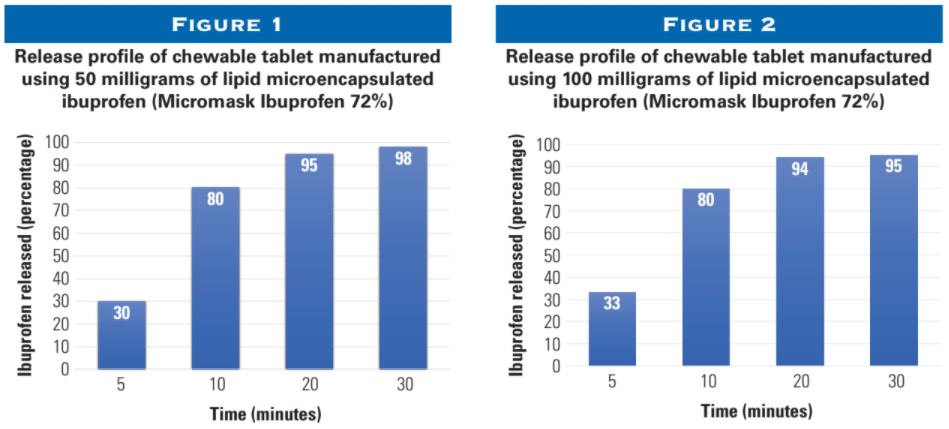
As the figures show, the products meet the USP monograph release criteria for ibuprofen, with both the 50- and 100-milligram tablets consistently releasing 80 percent of the ibuprofen within 10 minutes. Also, the taste tolerance of the 50-milligram chewable ibuprofen tablet was acceptable to children, validating that lipid microencapsulation works well for taste masking unpleasant-tasting actives.
In the nutraceutical industry, lipid microencapsulation has been used for several vitamin products to aid contract manufacturers in product development. Examples of these products are niacinamide, manganese sulfate, ferrous sulfate, pyridoxine hydrochloride, thiamine mononitrate, riboflavin, ferrous fumarate, magnesium oxide, ascorbic acid, zinc oxide, and polysaccharide iron complex.
As these examples show, lipid microencapsulation can provide solutions for formulating with challenging new active ingredients. The congealing methodologies used to form the lipid-active microparticles are established and proven in the industry, and the number of approved products using lipid microencapsulation is expected to continue to grow in the next few years [2].
References
- Globe Newswire. 2020. “The Microencapsulation market is projected to grow at a CAGR of 12.9%.” ReportLinker. Retrieved from www.globenewswire.com/news-release/ 2020/09/24/2098533/0/en/The-microencapsulation-market- is-projected-to-grow-at-a-CAGR-of12-9.html.
- Conrad Winters, Paula Cordiero, and Márcio Tem- tem. “Spray congealing: applications in the Pharmaceutical Industry.” Chimica Oggi - Chemistry Today. 2013. Vol. 31, No. 5. Retrieved from www.teknoscienze.com/Contents/Riviste/ PDF/CO5_2013_RGB_71-75.pdf.
- Catalent. 2020. “Boosting Bioavailability: How Com- panies Are Using Advanced Technologies to Formulate Complex Molecules.” Retrieved from www.paperpicks. com/boosting-bioavailability-how-companies-are-using- advanced-technologies-to-formulate-complex-molecules/.
- Takeshi Harayama and Howard Riezman. “Understanding the diversity of membrane lipid composition.” Nature Reviews Molecular Cell Biology. 2017. Vol. 19, pages 281- 296. Retrieved from https://doi.org/10.1038/nrm.2017.138.
- David Chambers, Christopher Huang, and Gareth Mat- thews. “The Cell Membrane.” Chapter 4 in Basic Physiology for Anaesthetists (pages 13-17). Cambridge University Press. Retrieved from https://doi:10.1017/9781108565011.007.
- Basavaraj K. Nanjwade, Didhija J. Patel, Ritesh A. Udhani, and Fakirappa V. Manvi. “Functions of lipids for enhancement of oral bioavailability of poorly water-soluble drugs.” Scientia pharmaceutica. 2011. Vol. 79, No. 4, pages 705-727. Retrieved from https://doi.org/10.3797/ scipharm.1105-09.
- Silvy Cherian, Brian Sang Lee, Robin M. Tucker, Kevin Lee, and Gregory Smutzer. “Toward Improving Medication Adherence: The Suppression of Bitter Taste in Edible Taste Films.” Advances in Pharmacological and Pharmaceutical Sciences, 2018. Vol. 2018, Article ID 8043837. Retrieved from https://doi.org/10.1155/2018/8043837.
- Julie Christensen. “How Long Do Vitamin Supplements Last in the Bottle?” SFGATE. Retrieved from https://healthyeating.sfgate.com/long-vitamin-supplements-last- bottle-11224.html.
Beverly Schad is a customer success innovation manager and Jen Gornet is executive coordinator at Particle Dynamics (314 968 2376, www.particledynamics.com). Particle Dynamics is a leading contract manufacturer for product development with global pharma and consumer health companies. The company provides a full range of solid dose applications and technologies, including granulation, spray drying, lipid microencapsulation, solid dose formulation with coating, tablet compression, encapsulation, and polysaccharide iron technologies.