By Luke HoskinTechnical Sales Manager I Holland Ltd.
Poor handling and aftercare procedures account for about 85% of punch-and-die problems. Cleaning reduces cross contamination—common tablet and tooling issues. It also enables an accurate assessment of tooling as part of a seven step maintenance procedure.
Why Clean?
Whether it’s product residue, oil, or grease, removing it from tooling prevents cross-contamination. The punch’s key and keyway are both prone to contamination buildup, so thoroughly check these areas. Cleaning also ensures accurate inspection and assessment because any product left behind on punches can hide cracks or chips.
Badly cleaned tooling practically invites sticking. If nobody cleans after a production run and residue remains, it can harm output. Any new product can stick to the old, resulting in visually undesirable tablets and weight variation.
An uncleaned set of tooling used to compress more than one product opens up cross-contamination possibilities. Even a trace of one product found in the tablet of another could lead to expensive product recalls, risks to patients, and legal issues.
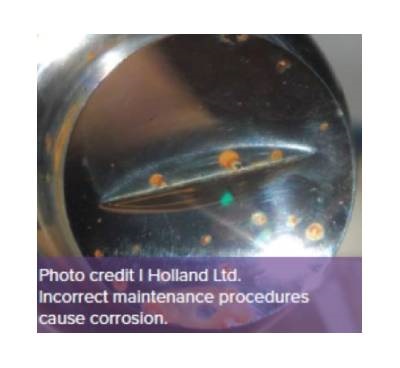
Insufficient and/or incorrect cleaning methods can also cause corrosion. Some formulations contain elements like chlorine, salts, and acids. When these corrosive chemicals react with the tooling surfaces, they trigger oxidation. Post-compression cleaning procedures can also cause corrosion if not completed correctly. Using a corrosion inhibitor during the rinse-and-clean cycle forms a protective layer.
The cleaning process itself can cause corrosion, if not done correctly. Hand-washing with water can rust tooling. Solvents reduce residue buildup on the tooling, but using them can be time consuming. Solvents could also damage the tooling’s delicate surfaces.
How to Clean?
Cleaning consists of four principal components: time, temperature, mechanism, and chemistry. These steps work together to achieve a cleaning cycle. Time and temperature are self-explanatory. Chemistry refers to the effectiveness of the detergent, and mechanism indicates the cleaning method—for example, manual cleaning with a brush, or an ultrasonic process.
Improving effectiveness of any step—for example, by raising the temperature or increasing the cleaning time—reduces the requirement for other processes. Because ultrasonic cleaning is such an effective technique, you can reduce other steps, like lessening cleaning cycle time or lowering temperature.
The mechanism employed in ultrasonic cleaning is called sonication, in which a transducer pushes sound waves through the cleaning solution in the tank, creating millions of tiny bubbles during the cycle. These bubbles rise through the cleaning solution and implode on impact to remove contamination. Depending upon the unit’s size, the tanks can hold many tools that can be cleaned in cycles under 10 minutes. Some units can also vary their intensity, thus cleaning heavily soiled tools in a shorter cycle time.
Efficient Production
Without regularly employing effective and repeatable cleaning procedures, tablet production could take a hit. To achieve maximum productivity and quality, cleaning should be completed after every campaign, and before storage.
Effective cleaning reduces many common tablet and tooling problems, resulting in a better product. Consequently, putting the effort into a sound cleaning regime generates dividends by enhancing production, thus saving time and money.