 Julien Lamps,Lonza
Solid oral dosage forms (SODFs) are patients’ preferred way to take medications. According to a 2017 Kiplinger report, eight of the 15 all-time top-selling drug products are SODFs, including the number one top seller1. While the number of parenterally administered biologic drug products has been increasing, many patients find injections painful, stressful, and inconvenient. SODFs remain the preferred method of delivering active pharmaceutical ingredients (APIs) for drug formula product developers as well due to their cost-effectiveness, relative ease of manufacturing, and array of patient-friendly dosing options. As a result, the number of SODFs being approved and in development is increasing, with the SODF market expected to reach $926.3 billion by the end of 20272. In 2018, 53 percent of the new molecular entities (NMEs) approved by the FDA were SODFs, an increase over the previous two years (50 percent in 2017 and 32 percent in 2016)3.
Although compressed tablets currently dominate the SODF market, hard capsules come in a close second, and interest in their use is growing. This is largely driven by the fact that formulators view encapsulation as a reliable delivery method for a range of compounds, including highly potent APIs. In 2018, approximately 25 percent of new chemical entities were considered to be “potent,” a trend largely attributed to the fact that about one-third of all drug candidates in development are oncology treatments4, 5. Of the 31 solid-dose oncological NMEs approved in 2018, seven were capsules.
The shift to plant-based and clean label capsules
Traditionally, hard capsules have been made from gelatin, which is manufactured using collagen protein, a natural by-product of the meat industry. Gelatin-based hard capsules offer traditional benefits such as swallowability, ease of manufacture, and cost-effectiveness, and they are proven to be compatible with a range of APIs and fill materials. For years, few alternatives could offer the same characteristics. However, advances in material science and organic chemistry over the past decade have produced capsule polymers derived from non-animal sources that offer performance and compatibility similar to that of gelatin.
First and foremost, pharmaceutical companies look for the most compatible capsule technology they can find for a formulation to ensure the safety and efficacy of the final product. However, developers of all types of therapeutics, especially nutraceuticals, also respond to emerging social and cultural trends. In recent years, these trends have included increasing consumer demand for products that are free of any animal proteins and that contain only “clean label” colorants and ingredients from natural sources. Hard capsules made from hydroxypropyl methylcellulose (HPMC), which is derived from cellulose found in trees, show great potential for meeting these emerging consumer demands and becoming the best-practice alternative to gelatin-based capsules.
Formulation benefits of HPMC
To maintain their plasticity, gelatin capsules must have a relatively high water content. This has occasionally led to concerns when developing hygroscopic formulations due to water exchange between the gelatin capsule shell and the encapsulated formulation. HPMC capsules have a low moisture content and are not susceptible to water exchange, which improves their chemical and physical stability, increases their shelf life, and mitigates the challenges associated with moisture-sensitive APIs and excipients. HPMC polymer can also withstand a wider range of temperature variation and fluctuation than gelatin, reducing the chance that the capsules will become brittle or break during storage or transit.
With potent NMEs under development, the challenges of deploying APIs in gelatin-based capsules are contributing to a shift toward the use of HPMC-based capsules. Currently, HPMC-based capsules are widely preferred in clinical trials and for many investigational NMEs because they have the added flexibility to accommodate a vast array of drug products and formulations6.
The primary factors driving developers toward HPMC capsules are the difficulty of containing hygroscopic APIs in gelatin and issues with gelatin capsules suffering from cross-linking reactions, which are chemical alterations to the gelatin that can hinder dissolution. Other benefits of HPMC capsules include:
- Reduced risk of interaction, resulting in less analysis and faster development;
- Sourcing confidence and reliability; and
- A broad range of applications. With fewer barriers and more application options, pharmaceutical buyers are increasingly moving toward HPMC-based capsules for their new drug products7.
Patient-friendly dosing with capsules
Most patient groups respond well to hard capsules because they are easy to swallow, require less frequent dosing, and reduce or eliminate unpleasant side effects. Advances in encapsulated medications and capsule material science are playing a prominent role in helping to achieve these benefits. For example, controlling the release profile by pelletizing the API is an effective way to prevent dose dumping—a major source of side effects.
Encapsulated multiparticulate forms such as multiple-unit pellet systems (MUPS), spheronized APIs, and fixed-dose combination (FDC) systems offer drug developers effective ways to control and manipulate complex modified and controlled release of APIs. These formula tion techniques offer developers great utility and flexibility for delivering APIs in vivo and demonstrate more reproducible pharmacokinetic (PK) and pharmacodynamic (PD) behaviors—including for poorly soluble, potent APIs—compared to traditional methods, resulting in improved therapeutic performance in patients8, 9, 10.
Manufacturers recognize hard capsules as one of the best ways to deliver these pelletized API forms because of their compatibility with the capsule shell, reduced formulation times, and economical and efficient manufacturability.
HPMC for future formulations
Developers of both new and generic drug products are increasingly interested in using HPMC capsules because of their stability, versatility, and patient satisfaction. Advancements in HPMC capsule technology are leading to broader compatibility with the more complex drug products currently in development and dissolution performance that is comparable to that of gelatin. Early HPMC capsules included gelling agents that could cause variability in the capsules’ in vitro dissolution. New HPMC capsule technologies eliminate the gelling agents to provide ion- and pH-independent dissolution performance in various dissolution media, as shown in Figure 1.
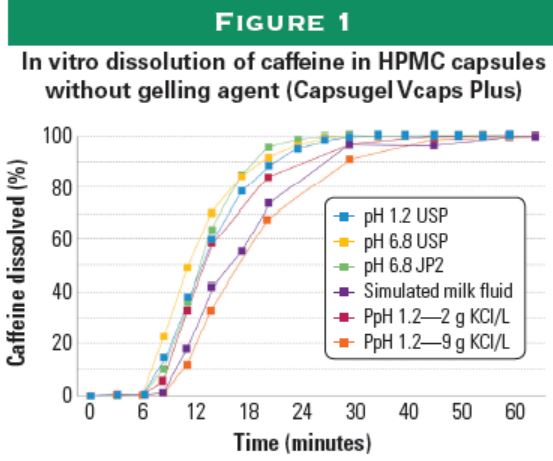
This feature addresses patient compliance concerns, as it permits patients to take the medication under either fasted or fed conditions. HPMC capsules have also been optimized to stabilize formulation performance even in low-humidity and low-moisture conditions. This offers formulators greater flexibility and allows HPMC to be a standard, reliable alternative to gelatin for the next generation of drug products11.
Specific grades of HPMC are also ideal for targeting API release in the gastrointestinal (GI) tract. Targeting dispersion to occur along a specific point in the GI tract is proving to be an effective delivery strategy for certain therapeutics12. Depending on the capsule’s film composition, this control can be relatively precise.
Enteric capsules manufactured with hydroxypropyl methylcellulose acetate succinate (HPMCAS) and HPMC can greatly simplify and accelerate prototype development and rapid in vivo testing of products requiring targeted delivery to the upper GI tract. Enteric capsules eliminate the need to develop, scale-up, and validate an enteric coating step; allow rapid screening and optimization of enteric performance; remove process variability as a factor influencing enteric functionality; and obviate the need for coating system preparation and application steps during production.
A new era of functional development
Polymer science and engineering have opened a new era of functional development that allows formulators to select the optimal capsule for each API. HPMC capsules not only offer mechanical stability for manufacturing, they also offer excellent formulation stability that eliminates compatibility issues and helps formulators accelerate development timelines and provide both immediate and modified-release alternatives.
References
1. https://www.kiplinger.com/slideshow/investing/ T027-S001-the-15-all-time-best-selling-prescriptiondrugs/ index.html
2. https://www.futuremarketinsights.com/reports/ oral-solid-dosage-pharmaceutical-formulation-market
3. https://www.pharmamanufacturing.com/articles/ 2019/solid-dose-under-hyped-but-not-under-represented/
4. http://www.samedanltd.com/uploads/pdf/white_ paper/9908ae04a14145d662675ac2eb0e0e5c.pdf
5. https://www.contractpharma.com/issues/2018- 09-01/view_features/hpapi-market-trends/
6. https://www.ncbi.nlm.nih.gov/pubmed/21092714
7. https://www.ncbi.nlm.nih.gov/pubmed/21092714
8. https://www.researchgate.net/publication/ 259578506_A_current_technology_for_modified_ release_drug_delivery_sytsem_Multiple-Unit_Pellet_ System_MUPS
9. https://www.researchgate.net/publication/30458 2250_Challenges_in_Protein_Formulation_Focused_on_ Extrusion-Spheronization_Process
10. https://www.researchgate.net/publication/31059 1360_Rationale_and_strategies_for_formulation_development_ of_oral_fixed_dose_combination_drug_products
11. https://www.ncbi.nlm.nih.gov/pubmed/19900518
12. https://www.biopharma-reporter.com/Article/ 2019/03/18/Oral-delivery-of-biologics
Julien Lamps is product manager, capsules and health ingredients, at Lonza (201 316 9200, www.lonza.com). The company manufactures Capsugel HPMC capsules, including Vcaps Plus immediate-release capsules, which disintegrate and release their contents independent of pH levels, and Vcaps Enteric capsules, which offer an alternative to enteric coating as well as potential product differentiation and life-cycle management.