 Yukiko Suganuma Daicel
Improving medication adherence is an important aspect of patient-focused pharmaceutical development. Typical approaches for improving adherence include changing the route of administration from intravenous to oral and reducing the dosing frequency. Orally disintegrating tablets (ODTs) are one of the most popular dosage forms for improving medication adherence. ODTs disintegrate in saliva in the oral cavity without requiring water. This allows patients with dysphagia, as well as geriatric and pediatric populations, to easily swallow the medication.
Traditionally, manufacturing ODTs required special processes, such as lyophilization and molding. However, since the early 2000s, manufacturers have been using an alternative, direct-compression process, as it enables the production of ODTs using conventional tableting and packaging equipment. Currently, several co-processed excipients for ODTs have been launched to produce ODTs more easily using direct compression1. Co-processed excipients provide not only good performanceas ODTs, but also applicability for the direct-compression process. The following study evaluated a novel co-processed excipient for ODTs (HiSORAD) from the viewpoints of suitability as an ODT and applicability for direct compression.
Ingredients and particle characteristics
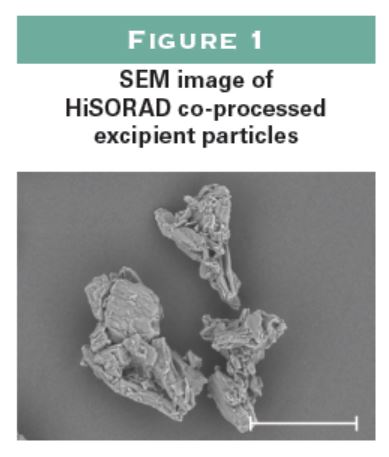
The co-processed excipient is composed of three excipients listed in the US, European, and Japanese pharmacopoeias: mannitol, microcrystalline cellulose, and croscarmellose sodium. These three ingredients are co-processed into nonspherical- shaped particles with a mean particle size of 106 microns. The nonspherical shape is purposely designed to enable better content uniformity in tablet form. A scanning electron microscope (SEM) image of sample particles is shown in Figure 1.
Disintegrability and compactability of placebo ODTs
To prepare the ODTs, the co-processed excipient is blended with one or more active pharmaceutical ingredients (APIs), flavors, sweeteners, and lubricants and then compressed using a conventional tablet press. Placebo ODTs showed satisfactory rapid disintegration and compactability without the addition of disintegrants or binders. The disintegration time is plotted against tablet hardness in Figure 2a, with the disintegration time measured both by sensory evaluation (in vivo) and the pharmacopoeia test method (pharmacopoeia). Even at a tablet hardness of around 100 newtons, the ODT tablets maintained a short disintegration time (<20 seconds). Moreover, the co-processed excipient showed excellent compactability. As shown in Figure 2b, the tablet hardness reached around 100 newtons under a compression force of only 5 kilonewtons, demonstrating that the excipient might be suitable for application with poorly compressible APIs.
Hygroscopic stability of placebo ODTs
As a small amount of water is a trigger for the disintegration of ODTs in the oral cavity, it is generally difficult to maintain robust hygroscopic stability in terms of tablet hardness for ODTs. However, the co-processed excipient provided satisfactory stability in placebo tablets. Placebo ODTs were stored open at 25°C/75 percent relative humidity (RH) for 3 months, with the tablet hardness, disintegration time, tablet thickness, and tablet weight evaluated at intervals, as shown in Figures 3a and b. Tablet hardness decreased gradually, but the difference was only 25 percent after 3 months. This decrease in tablet hardness seems sufficiently small for practical use. The increase in tablet thickness was also sufficiently small at only 0.07 millimeter. The results of a stability test at 40°C/75 percent RH are shown in Figures 4a and b. The tablet hardness decreased by only 30 percent, and the thickness increased by only 0.09 millimeter, indicating that the co-processed excipient seems to maintain the practical hygroscopic stability of ODTs.
ODTs with APIs
The co-processed excipient also demonstrated the ability to load a high dose of APIs while maintaining high hardness and rapid disintegration. In fact, the upper limit of API content depends on the API’s water solubility. When an API accounted for 30 to 50 percent of the tablet weight, trial ODTs exhibited satisfactory hardness (greater than 40 to 50 newtons) and rapid disintegration (<30 seconds), as shown in Figure 5. Especially, when the ODTs contained poorly water-soluble APIs (such as ibuprofen or ethenzamide), they exhibited excellent hardness and disintegration properties at API content from 50 to 70 percent. This high dosing capacity demonstrates the co-processed excipient’s suitability for use with processed APIs, such as coated APIs for controlled release.
Content uniformity in ODTs
Direct compression is the simplest tableting method, contributing to both energy savings and cost advantages. However, maintaining content uniformity in direct-compression tablets can be challenging, because it requires powders with different physical properties to be mixed directly without any preprocessing. This study evaluated the content uniformity of direct-compression ODTs made with the co-processed excipient using a lab-scale rotary tablet press. Tablet samples were taken initially and at 20, 40, and 60 minutes, then the API content in each tablet was evaluated, as shown in Figure 6. The APIs were ibuprofen as a charged API and ascorbic acid as a non-charged API. Each formulation contained only 1 percent API.
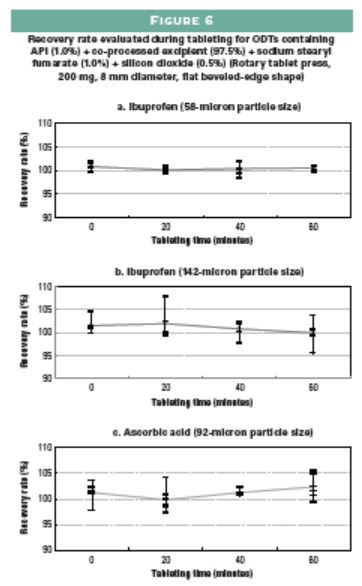
In ODTs with 58-micron ibuprofen particles, which is slightly smaller than the co-processed excipient’s particle size, the coefficient of variation (CV) calculated from all obtained tablets was 1.0 percent. Similarly, the CV of ODTs using 142-micron ibuprofen particles was 2.4 percent, which seemed acceptable for such relatively large API particles at such a low dose (1.0 percent). The particle size of ascorbic acid was similar to that of the co-processed excipient (92 microns), and the CV of ODTs with ascorbic acid was 2.2 percent, even though, because it is a non-charged API, there was no interaction between the ascorbic acid and the excipient. Additionally, no time-dependent segregation tendency was observed in any ODT. From these results, it seems that the co-processed excipient, with its nonspherical particle shape, provides adequate content uniformity for the direct-compression process. Nonspherical particles are assumed to be able to hold APIs in a powder mixture. These findings suggest that the excipient is suitable for formulations with various types of APIs with a wide range of physical properties.
Conclusion
The co-processed excipient HiSORAD for direct-compression produced ODTs with excellent disintegrability, compactability, hygroscopic stability, and content uniformity. Future research might also be conducted to determine its applicability for continuous manufacturing.
Reference
1. Takahiro Hiramura and Makoto Narushima, “Eye on Excipients,” Tablet & Capsules, March 2016, page 37.
Dr. Yukiko Suganuma is in charge of technical support and marketing for Daicel in Japan (daicel-excipients@jp. daicel.com, daicel-excipients.com).