 Rachel Smith University of Sheffield
Wet high-shear mixer granulation is a particle size enlargement process in which fine powder is combined with a liquid binder. As the binder is sprayed into the process bowl, the granulator’s impeller and chopper blades shear the powder. The resulting granules have specific desirable properties, including, for example, particle size, granule strength, bulk density, dissolution time, compressibility, and content uniformity.
To achieve the desired granule properties, you can modify several operating parameters, including granulator geometry and size, impeller speed, chopper speed (if any), binder-addition method and flow rate, and granulation time.
The traditional approach to scaling up high-shear granulation has been to increase the process size by small increments and troubleshoot at each new scale. The reality is that changing granulator scale affects all of the granulation mechanisms in different ways, and no set of scale-up rules will encompass all the changes. You must consider the effect of scale on each of these mechanisms if you want to increase batch size while retaining similar attributes in the final granules.
These days, we usually think of granulation as occurring through three simultaneous and, at times, competing mechanisms: nucleation, growth and consolidation, and breakage1. Nucleation can be considered the first step in the process and involves the initial formation of granules, called nuclei. In the case of high-shear granulation, nuclei are formed when liquid first hits the powder bed and interacts with the particles, as shown in Figure 1a.
Granule growth occurs through primary particle layering on a granule’s surface and through coalescence of two or more granules (Figure 1b).
This step generally also densifies the granules. Granule breakage occurs when the stresses in the granulator (either shear stresses or normal stress from impact with the impeller or chopper blades or granulator wall) exceed the granules’ strength, and the granules fail (Figure 1c). Changing each of the operating parameters listed above may change the rate and regime of each granulation mechanism, and therefore change the granule properties. Below are some suggestions and comments on how to approach each operating parameter.
Granulator Geometry
In many industries and applications, you may have no control over the granulator geometry. However, if you have a role in purchasing or designing new granulation equipment, it’s generally best to select or design a granulator geometrically similar to—that is, with the same height-to-diameter ratio—as the machine you’re scaling up from. Choosing geometrically similar granulators generally means that scaling the impeller speed becomes a simpler process.
Impeller speed
Scaling impeller speed isn’t a trivial exercise. The effect of impeller speed on granule size depends largely on your formulation’s properties and on the process’s dominant granulation mechanisms. In some cases, increasing impeller speed will lead to higher granule growth; in other cases, higher impeller speed leads to greater breakage rates and, hence, smaller granule size distribution.
One of the most important things to consider is the flow pattern within the granulator. Most granulators should be run in the roping regime, where the powder bed moves in a toroidal flow pattern within the granulator (Figure 2a) [2]. If the impeller speed is too low, the granulator will operate in the bumping regime, where the surface of the powder bed moves very slowly, bumping in phase with the impeller blades’ passing (Figure 2b). The roping regime is important for good mixing and liquid distribution within the granulator and has a major effect on the nuclei size.

Several scaling rules have been proposed for scaling impeller speed in high-shear granulators. Some authorities advocate scaling with constant tip speed, while others suggest scaling with a constant Froude number (the ratio of centrifugal to gravitational forces in the granulator). Work by other researchers suggests scaling using constant shear stresses inside the granulator3. The researchers propose scaling using this relationship:
Chopper Speed
The role of the high-shear granulator’s chopper (if so equipped) isn’t clearly defined. Depending on the bulk mixture’s properties, it can either grow and densify agglomerates or have a role in granule breakage4. Increasing the granulator bowl’s size will decrease the frequency of interaction between the granules and chopper. Scaling the chopper to have the same tip speed in this case may be a good idea, as the granules will experience similar impact forces. However, if other scale-up changes have caused an increase in granule size, increasing chopper speed may help reduce granule size.
Binder addition method and flow rate Advances in granulation research have led to the development of the nucleation regime map, a tool describing the type of nucleation behavior that can be expected in a given granulation process5. This map has two dimensionless parameters: the dimensionless drop penetration time (the time for a liquid binder drop of characteristic size to fully immerse into the bulk powder) and the dimensionless spray flux, which can be thought of as the ratio between the liquid spray rate and the particle turnover rate at the powder bed surface.
Low drop penetration time (that is, quickly penetrating drops) and low spray flux (that is, drops that are well spread out on the powder surface) place the nucleation behavior in the drop-controlled regime, which means that most of the nuclei will be formed from a single droplet, resulting in a narrow nuclei size distribution. High values of either drop penetration time or spray flux will lead to over-wetting and liquid pooling at the powder bed surface, creating large nuclei that require mechanical forces to disperse.
This is known as the mechanical dispersion regime and leads to a wide nuclei distribution. In essence, the nuclei size distribution is the granulation starting point, and for many formulations it’s important to form similar nuclei size distribution across the granulator length. If the granulation process you’re scaling up from operates in the drop-controlled regime, it would be beneficial to design the spray nozzle for the larger-scale process so that the drop size is similar to the original scale (maintaining similar drop penetration time) and the dimensionless spray flux remains low (resulting in single drop nuclei). Methods to reduce the spray flux ensure that the spray width covers the powder bed’s available surface (that is, the granulator’s radius), reducing the liquid binder’s volumetric flow rate and increasing the powder velocity.
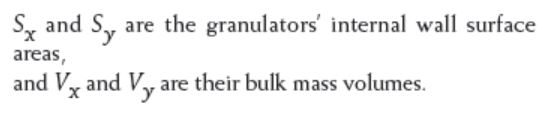
Granulation time It’s difficult to know how granulation time will affect granule properties across different granulator lengths. Mechanical distribution of the liquid binder may take longer in a larger granulator; however, this will largely depend on your formulation and other operating parameters. One recommended method to scale granulation time in the granulator is to use the relationship described by the equation below6:

Know your process High-shear granulation scale-up is still a hit-and-miss process, requiring much trial and error. However, recent developments have removed some of the art in this process, in turn injecting science into the decision-making process. The ultimate goal of granulation research is to be able to design granulation processes to give the desired granule properties without requiring labscale trials and scale-up. However, while we’ve seen advances, this goal is still a long way off. The most important part of scale-up is to know your process and use this knowledge in your decisions.
References
1. S.M. Iveson, J.D. Litster, et al., “Nucleation, growth and breakage phenomena in agitated wet granulation processes: A review,” Powder Technology, 2001, Vol. 117, No. 1-2, pages 3-39.
2. J. Litster and B. Ennis, The Science and Engineering of Granulation, Kluwer Academic Publishers, 2004.
3. G.I. Tardos, K.P. Hapgood, et al., “Stress measurements in high-shear granulators using calibrated ‘test’ particles: Application to scale-up,” Powder Technology, 2004, Vol. 140, No. 3, pages 217-227.
4. G.K. Reynolds, P.K. Le, et al., “High-shear granulation,” in Granulation (Handbook of Powder Technology), edited by A.D. Salman, M.J. Hounslow, and J.P.K. Seville, Elsevier, 2007.
5. K.P. Hapgood, J.D. Litster, et al., “Nucleation regime map for liquid bound granules,” AIChE Journal, 2003, Vol. 49, No. 2, pages 350-361.
6. N. Rahmanian, B.H. Ng, et al., “Scale-up of highshear mixer granulators,” KONA Powder and Particle Journal, 2008, No. 26, pages 190-204.
Rachel Smith is a senior lecturer in the Department of Chemical and Biological Engineering at the University of Sheffield, Mappin Street, Sheffield, S1 3JD, UK. Tel. +44 114 222 8255 (rachel.smith@sheffield.ac.uk). She holds a BEng and a PhD in chemical engineering, both from the University of Queensland, Brisbane, Queensland, Australia. She’s been working in the fields of granulation and particle technology for 18 years. A version of this article first appeared in the June 2012 issue of Powder and Bulk Engineering.