 Anshul Gupte, Ph.D.Senior Director, Scientific & Technical Affairs Catalent
Andy MaitlandDirector of Operations & Supply Chain Catalent
There’s no universally agreed definition of what constitutes a highly potent API (HPAPI). But a health-based exposure limit (HBEL) can serve as a more reliable indicator of whether an API is potent or not. However, when evaluating a program, it is advisable to start with the mind-set of “how potent” the API is, then decide “how much” containment it will need.
As with handling HPAPIs at any stage of processing, if formulation requires micronization to reduce the particle size to help improve bioavailability, or achieve a specific particle size distribution, then there are a number of considerations.
Safety comes first. And to ensure operator safety and prevent cross-contamination, three factors should be considered:
- people, including the procedural controls, personal protective equipment (PPE), and necessary training;
- equipment, including engineering controls at source (e.g., the use of isolators) as well as flexible and/or single-use containment systems, which are becoming more important in contract manufacturing;
- rooms, where airborne cross-contamination can be controlled with purpose-designed environments, for high potent handling including, for example, airlocks, misting showers and singlepass high-efficiency particulate air (HEPA) filters.
Depending on what stage of drug development the program is at, toxicity information on the API may be incomplete. In these cases, default classifications (both potency and toxicity) are typically applied and a conservative approach adopted to ensure worker safety during handling and manufacturing. A reassessment may be made later and controls relaxed if toxicity is lower than first estimated.
In onboarding an HPAPI program, match the compound to the micronization equipment capabilities, then secure appropriate containment equipment. Also, consider the desired yield and particle specification at the necessary scale. Additionally, identifying an effective cleaning strategy of apparatus that is used in multi-purpose manufacturing facilities—as is typical for CDMOs— minimizes the risk of carryover of material between programs.
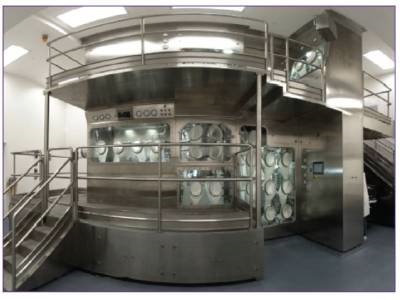
Once the material categorization has been assessed alongside the necessary control measures, options can range from processing non-potent APIs in an open bay, using flexible containers, or processing in hard-wall isolators for HPAPIs. For maximum containment, when processing HPAPIs, a hard-wall approach is the most effective, and can enable facilities to handle materials with occupational exposure limits (OELs) as low as tens of nanograms per cubic meter.
Analytical testing is applied for potent compounds for method development and validation specific to the potent API or potent drug product. Additionally, equipment used in the production of potent products is subject to cleaning verification and validation methods prior to release.
Also, consider the effect of containment on analytical tasks, which may negatively impact the dexterity of individuals working in isolators—especially when handling very small quantities of API or product. This is important during method development because methods that involve opening and weighing aliquots of the drug product (e.g., capsules, bottles, stick packs) are challenging for analysts under such conditions. “Whole unit” analytical methods avoid sample preparation in the isolator.
To further increase safety, micronizers can be installed within isolators purged with nitrogen to eliminate the risk of dust explosion for compounds with low minimum ignition energy values. Facilities can be installed up to commercial scale, and can provide increased efficiency by using continuous operations, eliminating the need to stop and change out raw material or product drums. Incorporating automated washing systems can reduce the need for operator intervention, while configuring equipment to accommodate flexible in-process sampling can reduce this further.
Handling HPAPIs in a development and manufacturing facility requires the consideration of several criteria to ensure safety and prevent cross-contamination. However, with appropriate containment, supplemented by procedural control and trained personnel, safe and effective handling is possible.