 Edward J. Bauer Edward J. Bauer and Associates
Big political change is remaking previous certainties, and people of all political views can see that healthcare is going to change. One early attempt—repealing or amending the Affordable Care Act (ACA)—failed. But something new will likely take its place eventually.
There is new leadership at both Health and Human Services (HHS) and the Veterans Administration (VA), and a new FDA commissioner is on the way. The changes at these organizations will have a huge effect on how healthcare is delivered to patients. Furthermore, there are prominent business people in key federal positions, and a physician now runs HHS. I expect them to take a fresh look at healthcare and perhaps experiment with new ways to improve it and reduce costs.
In addition, insurance companies—wiser from their experience with the ACA’s exchanges—may now embrace the idea that pharmaceutical packaging can reduce the cost of treating chronic illnesses in our aging population. That spending is larger than in any area of healthcare delivery. Regulation is also likely to undergo major change, although no one knows exactly how. The new administration has discussed giving faster approval to new facilities and expansions. That would allow new and novel processes to be brought to market more easily and quickly. The president’s order that two regulations must be eliminated for each regulation added is itself new and novel. Since when has governmental oversight entailed eliminating regulations? The approach could even lead to scrutiny of the FDA’s “Guidance for Industry” documents, which have become de facto regulations.
President Donald Trump has also signaled a desire to bring manufacturing jobs back to the USA. That could mean domestic production of active pharmaceutical ingredients (APIs) will increase in the next 4 years. It could also mean changes at pharmaceutical companies that outsource packaging and many other functions. Will the current model survive as is?
Instead of trying to predict exactly what will change, this article makes the case for a new approach to pharmaceutical packaging. The logic of upgrading how we package pharmaceuticals is obvious, especially in the treatment of chronic diseases.
Ripe for Change
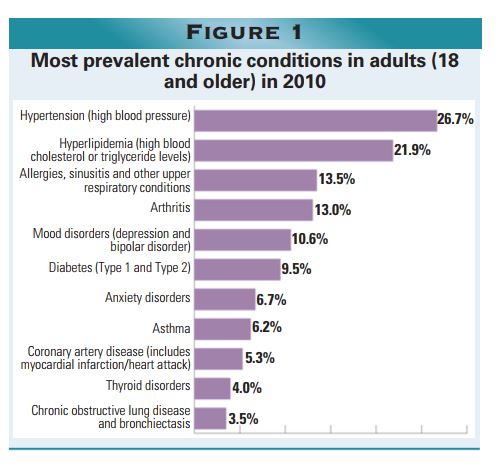
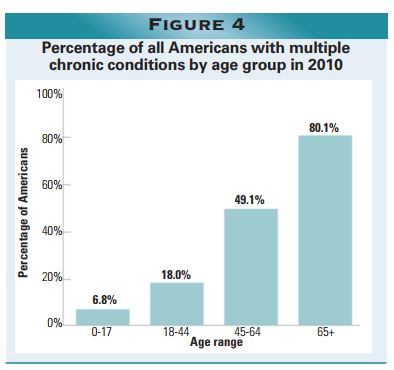
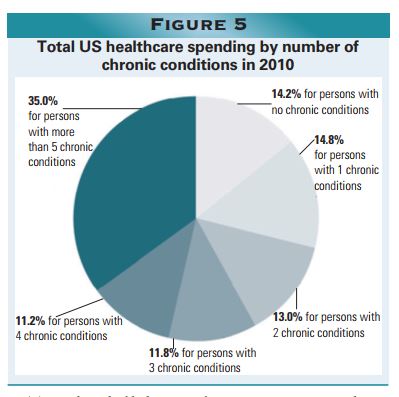
Changing how we treat chronic disease offers the biggest opportunity to reduce the cost of healthcare. Figure 1 ranks the prevalence of different chronic conditions, and figures 2 and 3 show how many suffer from multiple chronic conditions. In 2010, 86 percent of all healthcare spending was directed to patients with one or more chronic conditions, and 71 percent of all spending went to people with multiple chronic conditions [1]. We spend more treating these diseases than we do any other area of healthcare delivery. The problem in treating people with these conditions is twofold: The cost of the drugs and getting people to take them as directed. Cost
For many people. filling their prescription is expensive, and many must decide between paying for medications or other necessities. As patients will readily admit, many do not take their medications as prescribed and/or skip getting refills because of cost.
Adherence
Also known as compliance, adherence refers to how well patients follow the prescribed regimen of treatment. Adherence minimizes the effects of chronic conditions.
More than half the population, 51.7 percent, has a chronic condition, and it’s not restricted to the elderly, although they account for more of these conditions. Women are more likely to report multiple chronic conditions than men (34.7 percent versus 28.2 percent). Approximately 80 percent of people 65 and older have chronic conditions, and people in that age group account for a bigger share of total US spending on healthcare than any other. See figures 4 to 6, which detail actual spending in 2010. These numbers are important, because they reveal the biggest opportunity for healthcare savings available to this administration or any other.
The costs associated with chronic conditions skyrocket when they’re left untreated. Hypertension, for example, when left untreated could lead to a stroke. If so, the $1 to $2 per day it costs to treat hypertension—and possibly prevent a stroke—could become a yearly expense of $100,000 or more to provide convalescent care to the person who suffered the calamity.
Begin with Blisters
There are many ideas about how to address the problem of cost and adherence among those with chronic conditions. But the simplest and easiest, at least to start, is to use packaging technologies that make it simple for patients to take their medications as prescribed.
A good first step: Increase the use of blister packaging combined with custom labeling so it’s clear to people when and how to take their medications. It’s not unusual for seniors to have several pharmacy bottles on the kitchen table or countertop to remind them to take their medications. But many times, seniors forget whether they took their medication, just as all of us from time to time think we’ve done something that we haven’t or vice versa. Using blister packaging with enough space to accommodate the dose and a date code may be a simple way to fix this. Female hormone replacements—birth control tablets—use packaging that enables people to start taking their tablets any day of the month. Because the blister card indicates how many tablets you’ve taken, you know at a glance whether you took your meds that day. Let’s adapt this package for drug products that treat chronic conditions.
Increasing the use of blister packaging is not a far fetched idea. Most products used outside the USA are packaged this way. We’re the last major holdout, with cost often cited as the reason. But a comparison of packaging tablets in bottles versus blisters yields a surprising result. The breakpoint in the cost of using either package is almost always 30 to 40 tablets (or capsules), so let’s use 35 tablets for comparison. Thus, if the package will hold fewer than 35 tablets, then a blister would be less expensive.
If it will hold more than 35 tablets, then the bottle is less expensive. It’s interesting that the breakpoint is about equal to the number of days in a month. That means, by using blisters, you could establish two benefits in treating chronic conditions. First, people would know when and whether they took their medication and, second, when patients either do or don’t refill their 1-month supply, the pharmacist and physician can tell how well patients are following the prescribed course of treatment. In addition, because of how the information would be gathered, there would be few concerns about privacy. Those concerns are more likely to arise with internet-enabled devices that record behavior.
It’s surprising that better packaging isn’t promoted more by healthcare professionals, government administrators, and insurance companies. The VA conducted a very compelling study on how adherence-focused packaging improves patient outcomes [2]. Conducted at Walter Reed Hospital in Washington, DC, and known as the Federal Study of Adherence to Medications in the Elderly (FAME), the study tracked adherence of patients with high blood pressure and/or cholesterol. The results showed that the blister packaging led to a remarkable 97 percent increase in adherence after 6 months. The packages in the study went a little further than ordinary blisters, and included all the patient’s tablets/capsules in one blister cavity, with each cavity labeled by day and time. This type of packaging may be the next step to improve outcomes in the treatment of chronic conditions.
Already, many online pharmacies bundle multiple medications in a pouch or blister and label them clearly for patients. This kind of bundling is a big advance over the pillboxes that require people to remove their medications from the original packaging and drop them into a cavity— one for each day of the week—to track when to take their meds. But since pillboxes don’t specify the time of day to take the medications, they provide little help to people who take multiple medications throughout the day.
There are also electronic options, such as bottle caps that flash or emit a sound to remind people to take a tablet and then record when the bottle was opened. These options—many of them elegant and convenient— would be the second step once we’ve capitalized on the benefits of more widespread use of blister packaging.
Many seniors already receive e-mail or text reminders on their cell phones from companies like OnTimeRx. That approach and apps like it also provide other ways to help people address their chronic conditions or help loved ones. For instance, they help families serving as caregivers to support the treatment of chronically ill patients. It’s very difficult for family members to manage jobs, kids, and other responsibilities while also taking care of an elderly parent. With improved adherence, it’s not just patients who get a better quality of life. The family does, too. As with blister packaging, it’s surprising that insurance providers do not recommend or require healthcare providers to use these kinds of adherence-boosting technologies, which are readily available. They seem absent from the discussion, and that’s odd.
Costs will Climb
Times are indeed changing, but one fact is certain: The cost of healthcare is increasing every year. Continuing to deliver medication that treats chronic conditions using the same old methods won’t improve outcomes for patients. Intervention that is both simple and more effective starts with better packaging. It’s the best way to reduce what we spend and to increase the quality of life for people with chronic conditions. It’s a combination that should appeal to the business people now running the government. Change driven by a businessminded approach—coupled with a genuine concern for patients—should be a slam dunk. Greater adoption would benefit patients, patient cooperatives, insurance companies, and governmental healthcare providers like the VA. What are we waiting for?
References
1. The data and figures in this article are taken from “Multiple Chronic Conditions Chartbook–2010 Medical Expenditure Panel Survey Data.” Department of Health and Human Services, Agency for Healthcare Research and Quality. The report, published in April 2014, is available at www.ahrq.gov. 2. Lee JK, Grace KA, and Taylor AJ. “Effect of a Pharmacy Care Program on Medication Adherence and Persistence, Blood Pressure, and Low-Density Lipoprotein Cholesterol: A Randomized Controlled Trial.” (FAME study.) JAMA 2006 Dec 6;296(21) 2563-71.
Edward J. Bauer is president of Edward J. Bauer and Associates, Sewickley, PA. E-mail: edwardbauer@prodigy.net. He is the author of The Pharmaceutical Packaging Handbook, and has broad experience in all types of packaging for pharmaceuticals and dietary supplements. He was responsible for worldwide packaging at major pharmaceutical manufacturers and a medical device manufacturer. He is also an editorial advisor to Tablets & Capsules. His previous article on adherence packaging appeared in the May 2014 issue.