Sharon Nowak- Global Business Development Manager, Food and Pharma Coperion
Many chemical and pharmaceutical process engineers are challenged by metered dispensing of reactive powders into reactors and large tanks. But dispensing difficult to-handle ingredients in a contained and accurate method can be fulfilled and completely automated using specifically designed loss-in-weight (LIW) feeders. The combination of highly advanced weighing technology, and a contained and sanitary feeder design provides for an ideal automated method of powder delivery—without the dangers and inefficiencies of traditional manual powder loading techniques.
Application and Process Details
As shown in Figures 1 and 2, LIW feeders can be designed to dispense powders into a reactor, tank, or large process vessel. Figure 1 illustrates a single feeder, complete with a vacuum receiver mounted directly above the feeder, to transfer the powders from the floor below. Figure 2, however, illustrates the ability to also incorporate a bulk bag frame system above the feeder to deliver the powder to the feeding/ dispensing system. It also illustrates the use of a second, smaller LIW feeder on a portable weigh scale, which is used to dispense even smaller amounts of a second powder to the tank.

In order to maximize flexibility, feeders can be equipped with a special caster system on tracks, which enables the feeders to be rolled in and out of place as required and can also be placed on pneumatic lifts. The feeder in Photo 1 can be moved forward and back as well as up and down, and the entire unit can also be moved in and out of position. This system is ideal for hard-to-reach tank or reactor inlets.
In these LIW batcher designs, the efficient batching program included in the feeder controller is designed for a metered flood flow of material out of the feeder until the total weight of the material fed is within 90% of the batch weight setpoint. At this point, the controller automatically switches the feeder into a slower “trickle feed” mode in order to accurately reach the final setpoint weight. Based on the maximum achievable speeds determined with calibration, the controller also calculates the minimum batch time for the specified material.
Why Loss-in-Weight (LIW) Batching?
Batch size, number of materials, material characteristics and accuracy requirements will all influence which type of batching — loss-in-weight (LIW) or gain-in-weight (GIW) — makes the most sense. Figure 3a and 3b illustrate the differences in equipment setup for these two modes of batching. Typical accuracies, are +/- 0.5% of the full scale capacity. In other words, when batching into a reactor or vessel mounted on a scale or suspended from load cells, the full weight of the vessel and its contents must be reflected in the full-scale capacity. Most floor scales or high capacity load cells do not have sufficient speed and resolution to detect small amounts of batched products relative to the larger overall weights of the tanks, reactors, or process vessels. Use of a LIW feeder batch controller monitors material weight loss from the feeder hopper and controls the speed and start/ stop function of the feeder to control the achievement of the batch weight setpoint. In other words, it is only weighing the exact amount dispensed and does not have to account for the tare weight of the complete vessel.

Weighing System and Feeder Performance
Any LIW process controller requires accurate high-speed measurement of material weight changes to optimize feeder control and performance. The weighing system must also be able to filter out erroneous measurements due to plant vibrations or disturbances, and be stable over changes in process room or process material temperatures.
The keys to accurate batching are the higher resolution of weight measurement and speed of the controller. The faster those weight measurements are taken, the better the information that will be provided to the control algorithm to work, and the better any vibration filtering algorithm will work.
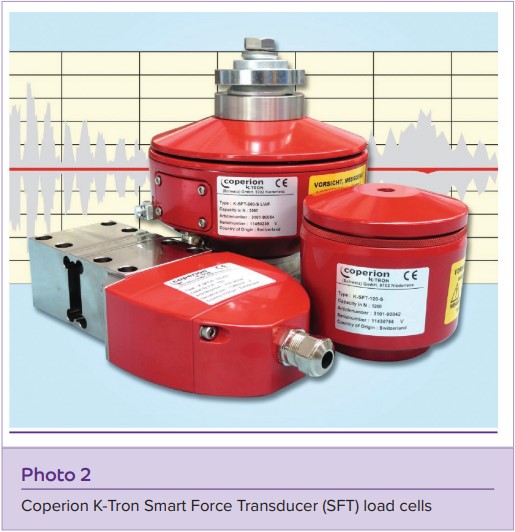
The advantages of weight control through custom technologies can certainly be a factor in the product quality and overall manufacturing costs. For example, Coperion K-Tron load cells, as shown in Photo 2, utilize a proven vibrating wire technology, which is based upon the theory that the resonance frequency of an oscillating wire depends on the wire tension produces when a load is applied. The force of an applied weight is transferred mechanically to the wire. The resonant frequency is measured to determine the weight.

In addition, the most recent improvements to the SFT load cell technology are built upon a custom integrated circuit, which allows continuous measurement and digital filtering capability at even higher sample rates. Previously there were short gaps of time between capturing the wire frequency, processing the weight, and restarting the frequency capture. The new system can capture an integer number of periods of the weight frequency using a 30 MHz reference frequency and never miss a single pulse—resulting in truly continuous measurement.
Options in Cleaning, Containment and Construction
Dependent upon the powders to be batched and frequency of batching, a variety of designs reduce the overall cleaning or changeover steps. Also, stainless steel for contact components allow for ease in cleaning and corrosion resistant operation, which also aids in chemical applications. Feeders and conveying receivers can be designed with in-place retractable spray balls for wash-in-place cleaning to ensure quick changeover and minimal contamination between material runs. In addition, for toxic chemicals or pharmaceuticals, split butterfly valves at the product outlet can be incorporated to ensure complete containment of the powder when the batch is complete and the feeder moved away from the vessel or reactor. When designing for a batching system, it is important to discuss all aspects of the design requirements, including the expected changeover and cleaning times, optimal desired batch times, containment requirements, and any issues with height limitations, as the design requirements for these situations can greatly affect the overall system cost.
Author Biography
Sharon Nowak serves as Global Business Development Manager for the Food and Pharmaceutical Industries for Coperion and Coperion K-Tron. Sharon has a 30+ year background in the process equipment industry for food and pharmaceuticals as well as a degree in Chemical/Biochemical Engineering from Rutgers University in New Jersey, USA. She has extensive experience designing and integrating feeders and material handling equipment including pneumatic conveying into continuous and batch processes for food and pharmaceuticals including blenders/mixers, mills/ micronizers, extruders, granulators and coaters, and contained processes for potent pharmaceutical compounds.
Coperion (www.coperion.com) develops, produces, and services plants, machinery, and components for the food, pet food, baking, pharmaceutical, and cosmetics industries. Its brands includeBakon, Coperion K-Tron, Diosna, Gabler, Peerless, Shaffer, Shick Esteve, Unifiller, and VMI.