
Part 1 of this article was published in March/April 2026 addressing encapsulation challenges which were rooted in the empty capsule manufacturing process, including pin design and other process related areas.
I recently had the unique opportunity to ride with a friend through a car parade in the passenger seat of a beautiful 1928 Model A Ford. Throughout the ride I marveled at the early engineering and mechanical controls which were developed in the pioneering era of automobiles. Not only did the Model A use a floor pedal for gas, it also had a throttle lever by the steering wheel which needed adjustment for idling and another lever for spark control. Driving in this classic car and hearing the roar of the “Ah-o-o-o-o-o-o-ga” horn caused me to remember the iconic and highly educational book, “The Machine That Changed the World.”1
Written in partnership with MIT’s International Motor Vehicle Program, it was a clarion call not only to the domestic automotive manufacturing industry, but to all industries to continually search out better ways of accomplishing our work or be left behind. The embracing of mass production principles had increased throughput over craft production but also reduced the responsibility of employees to repetitive single task operations with little room for process flexibility. An unintended consequence was that it removed some positive key influences of everyday personnel, such as innovation and collaborative troubleshooting.
“The Machine that Changed the World” outlines the revolutionary changes developed in Japan which brought back benefits of craft production while answering the supply demands needed by mass production. As shared by the authors, they were able to “employ teams of multi-skilled workers at all levels of the organization and use highly flexible, increasingly automated machines to produce volumes of products in enormous variety.”1
One of the important improvement theories developed in Japan during this period of quantum growth was Ishikawa’s fishbone, or cause-and-effect, diagram. The tool helps teams organize potential causes of a process problem into categories. Today, these categories are often described as the “5Ms and one P” representing: Machine, Material, Measurement, Method, Mother Nature, and People. When investigating a challenge, the diagram can be used to identify possible contributing factors in one or more of these areas for further evaluation.
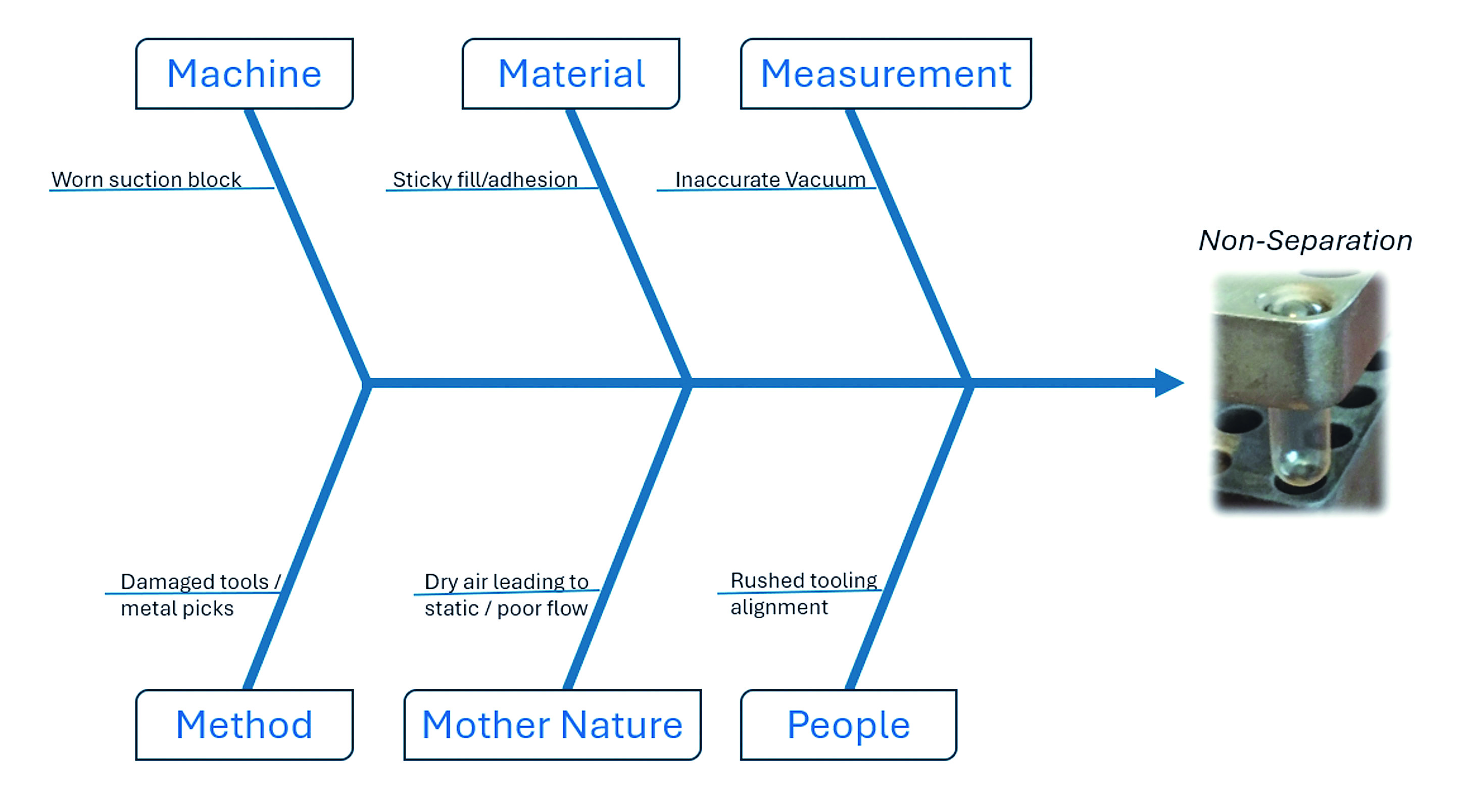
Applying the fishbone diagram to the capsule filling process, each of these areas can influence the outcome. For example, if you are experiencing non-separation in capsules, the following fishbone illustrates one potential contributing factor in each category. These factors should be investigated and verified before being identified as root causes.
The fishbone diagram is aptly named. Many fish species have between 150 and 300 bones, and likewise, if we were to list all the potential root causes for non-separation, and other capsule processing issues, the lists could be very lengthy.
Troubleshooting the capsule filling process becomes particularly complex when more than one factor is influencing the defect or issue. For example, a company may be having split and tuck defects which are being influenced by a machine with a mix of OEM and non-OEM parts, with a highly granular fill material, insufficient dust collection, on a humid day, with a new operator. This may seem like a ‘perfect storm’ set of conditions, but as a traveling technician for capsule filling, I can assure you that these kinds of scenarios happen quite frequently, and finding solutions can be complicated.
Oftentimes, customers try to fight these battles on their own for far too long before reaching out for collaborative help. Most empty capsule suppliers have technical support teams who are dedicated to helping you resolve issues, and at no extra cost. It is in the best interest of the supplier to ensure your success in running capsules as efficiently as possible, and even then, sometimes the fixes are not quick and easy. I will share a couple of examples where involving the empty capsule supplier’s technical support and other industry professionals helped to resolve challenging issues.
A Stalemate, Then Resolution
Some years ago, while working as a technical support representative, I was presented with a sudden and daunting issue. A large client who had purchased multiple new expensive capsule fillers was faced with an abrupt and near-complete shutdown, and the blame was quickly put on the capsules, with tens of millions of them being rejected for non-separation, and with millions more waiting in the supply chain. The capsules were thought to be at fault because some of the lot numbers of empty capsules worked better than others, but with no clear understanding of why. Rapid sampling was completed and over a short time, quality checks were performed on thousands of capsule samples at the manufacturing site, but only normal process variation was observed. There had been no changes to the capsule specifications or process that could explain the issue, and the same lot numbers were working for other capsule filling companies in the area.
The fact that some capsule lot numbers showed better performance than others caused the customer maintenance technicians and other leaders to strongly believe the issue must lie with the capsules and continuous pressure was applied on us to find a resolution.
The customer was hesitant to allow adjustments to be made on their new machines, as they were still under factory warranty, and the European technicians had left them operating well following installation. We were at a stalemate.
At the onset, I remember feeling quite alone and solely responsible for identifying and resolving the issues, losing sleep and being very stressed.
I measured the tooling bores of these new machines and found them to be dimensionally slightly tighter than other tooling commonly used in the industry. However, machine tooling and capsule dimensions are not governed by a single, universally adopted industry standard. Although tooling and capsule manufacturers work within generally accepted dimensional ranges, tolerances may differ among machine manufacturers, specialty tooling suppliers, and capsule manufacturers. These differences can create compatibility issues and disputes over responsibility.
Representing our customer and the company I worked for, I reached out to the manufacturer of the equipment for support. Over time and with persistence, technicians were flown in from overseas, and after long days of working together, new specifications were agreed upon and a solution was successfully tested, but it would not have happened without the collaborative work of the customer, the capsule technical support team and the equipment manufacturer.
When the changes had been fully implemented, we all watched the equipment pumping out quality filled capsules at maximum rated output and there was a huge feeling of both relief and satisfaction. Ah-o-o-o-o-o-ga!
Maximizing Output Through Collaboration
Another, less painful scenario occurred when a customer contacted our capsule company and shared that they experienced good quality using our size 00 elongated capsules but were unable to run them at the equipment’s maximum rated speed. Demand for this SKU was very high, creating an urgent need to increase machine output. We explained that throughout the industry, size 00 elongated capsules may be more difficult to run at maximum rated speed and that machines were commonly operated at approximately 80% of rated speed for this capsule size. The customer then asked if we could assist in finding a solution to this long-observed challenge. I remember the request hitting differently the second time — it was an invitation to challenge the standard, and it caused me to pause and admire their confidence in finding improvement.
This project also became a collaboration. I remember the first meeting we called; it brought together seasoned industry professionals with several decades of experience to develop improvements for this customer and others who might benefit in the future. Some were long-time heroes of mine, and I admired their attention to an improvement request made by one customer. With input from the group, design changes were developed, tested, refined and retested. Within just a few weeks, we found success. New tooling part numbers were then created for this application, enabling the customer’s size 00 elongated capsules to operate at the machine’s maximum rated speed.
Once again, watching the machine run successfully at full tilt brought a feeling of group satisfaction. The result was achieved because the customer requested technical support and industry specialists worked together.
Innovation
As a final example, about ten years ago, I visited with a long-term client and industry friend. During our conversation, he explained that powders were reaching production too often without being ‘encapsulation-ready.’ The company lost time and material on formulations that would not form a slug or consistently achieve the target weight. In other cases, poor predictability or changes in raw-material characteristics forced the production team to replace dosing discs at the start of a run.
Although the product development team had tools for predicting powder performance, those tools did not reliably indicate how a formulation would behave during encapsulation. To close this gap, the client asked whether our technical service team could develop additional tools to assess powder behavior.
Again, we were being invited into our customer’s circle in a trusted partnership to help resolve a difficult challenge. This request, after much brainstorming, led to an idea, which was taken to a team of industry professionals, who continued to develop and work it out until it could be properly engineered and built, and eventually patented. The device supports the evaluation of powder behavior before full-scale production, allowing them to select dosing discs and tamping settings more predictably and reduce the risk of the production losses described above. Although the project took several years to complete, the resulting device is now used by multiple companies.
Like the preceding examples, this innovation began with a customer seeking technical support and progressed because specialists worked together to develop a solution. This same collaborative approach becomes increasingly important as encapsulation challenges grow more complex.
Across the examples in this article, the most effective solutions emerged when customers raised difficult problems early, specialists tested ideas together, and everyone focused on evidence and improvement rather than assigning blame. Inviting the right partners into the discussion early may resolve an immediate problem and lead to improvements that benefit the wider industry.
The author would like to thank colleagues Bahi Mahesan, Tom Breshamer, and Alejandro Carbo for their thoughtful contributions and editorial support.
References
- Womack, J. R. (1991). The Machine That Changed The World. New York: HarperCollins.