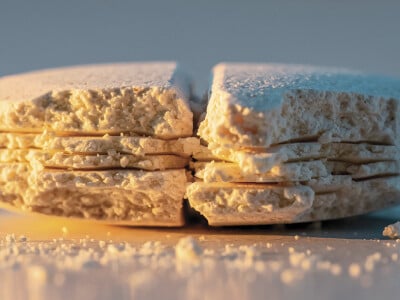
Tablet defects are costly, cause production shutdowns and often lead to a lost batch — and, even worse, a recall. They consume a lot of energy while teams gather and circle the problem. There will always be problems; expect them and be prepared for them. You can learn how to identify the issues by developing a game plan. Is it the tablet press, tooling, formulation, environmental, procedural, or the result of human error?
Tableting and encapsulation are the two most demanding unit operations in manufacturing, and they are often only messengers, showing results that may have begun in an upstream process. We hear it all the time: nothing has changed, so why is this happening? The answer lies in the fact that something has changed. Even the smallest amount of one ingredient can alter the outcome, or an operator might cut corners because they think their manager wants things done faster, which is often interpreted as ‘take a shortcut.’
Even if you only make one product day in and day out, every day will not be the same — expect problems and be ready for them.
Understanding the Difference
The most common tablet defects are capping and delamination. Tablet delamination and capping are related defects, often mistaken with one another, even among experts, and there is good reason for the confusion.
There is a level of complexity here and a need to properly define the differences and commonalities. Solutions for one may only lead to more problems with the other. Identifying the root causes of these defects is crucial for developing effective prevention strategies. Both delamination and capping may occur immediately after tableting or can show up later in coating or packaging.
Delamination
Delamination gets its name from the fact that the tablet splits into single and multiple layers. This can be caused by too much or not enough pressure. The dynamic here is understanding how particles and granules compact together.
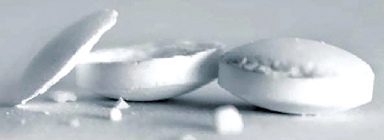
Complete capping and fractured capping
Particle and granule morphology are critical to success. A weak or friable particle/granule may break down due to excessive pressure; not enough pressure and the particles/granules may not lock together.
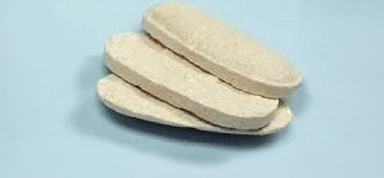
Delamination can be caused by many factors, slowing the press down significanly will be an indicator if the problem is the dwell time related.
A little too much pressure and the tablet delaminates, and not enough pressure and the tablet delaminates — the range of forgiveness is very narrow. Several factors play a role here. Tablet weight variation, thickness variation, dwell time factors (press speed, pre-compression, punch head flat variation), and variations within the blend of ingredients.
It’s important to note that there is no such thing as a perfect blend. All ingredients have a range when it comes to particle size distribution (PSD), moisture content, morphology, compressibility, friability, polarity, flowability, and bulk and tapped density. There will always be some tablet-to-tablet weight variation due to the blend and the nature of the ingredients. There will also be some variation in tablet weights due to the tablet press and tooling. Other factors include feeder type and feeder speeds, scraper blade condition, formulation recirculation, fill cam depth, die table condition, punch working length variation, and dust collection.
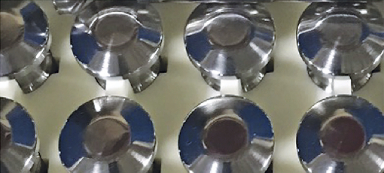
Punch head flat variation will cause tablet hardness variations with a dwell sensitive formulation.
Tablet weight variations may result from all the above. Tablets on target weight come out acceptably compressed and are good. The tablets with lower weights delaminate because of under-compaction (lower forces). Tablets that are high in weight delaminate due to over-compaction (too much force).
Delamination can occur anywhere within the tablet, from the top cap to the bottom cap, and in between. If it only delaminates on the top cap, it appears to be capping, but it is still considereed delamination.
Capping
Capping gets its name because the tablet cap separates from the tablet body at the line between the top cap and the tablet band. The tablet’s top cap fractures or separates, often due to the movement of fines during compression. These fines form a thin layer that prevents proper bonding of the ingredients. Fines typically are less compressible because of the poor morphology that doesn’t allow the particles/granules to lock together.

Tablet press tooling is designed to allow air to vent past the upper punch tip during compression, trapped air will cause capping.
Traditionally, capping has been referred to as air entrapment, which is partially correct. What has really happened is that the air carries the fines with it, forming a thin line of fines — the tablet’s weakest point — and the cap fractures, often completely separating from the rest of the tablet. The upper punch tip, which has a diameter slightly smaller than the lower punch tip, is designed to facilitate air release during compression. The smaller upper punch tip provides space for air to escape (vent) between the upper punch tip and the die wall during compression.
Fines are defined as particles that are smaller than 200 mesh (75µm). A small percentage of fines can enhance the tablet’s elegance. Too many fines — typically greater than 10% — are often where capping becomes more prevalent. The higher the fines percentage, the more critical it is to use pre-compression to lock the particles together before final compression, so that the fines cannot escape as air is evacuated. Too much pre-compression force, and the fines have already moved.
Other things, such as die compression wear rings and punch cup j-hooks, can cause tablets to look like they are delaminating and capping. Tablet sticking can also pull the tablet apart, making it appear as if it is delaminating or capping. Poorly blended or inadequate lubricant (excipient) can cause tablet ejection to be too abrupt, fracturing the tablet at take-off and making it appear as delamination or capping.
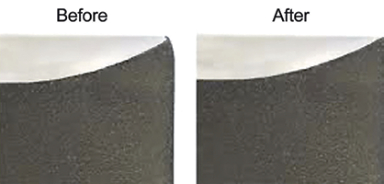
J-Hook: before and after polishing
The punch cup depth makes it more difficult to evacuate air. The deeper the cup, the more likely a tablet will cap. There are ways to maintain a deep cup depth and minimize the potential for capping. This can be done by modifying the cup radius.
Solving the Problem
Delamination and capping are interrelated defects. The first step is to optimize tablet weights; being within the pre-established range is often not sufficient. Make sure the scraper blade is in excellent condition before you start the press. Poor die scrape-off is a common problem. Optimized weight control means that compaction forces will be more uniform.
Press and feeder speeds can cause formulation segregation, though slowing down the press speed isn’t always the solution; sometimes, a higher speed is better. Feeder paddles help the formulation match the die tablet’s speed for proper die filling. A non-optimized formulation may have wide particle density variation; heavier particles fall faster, segregating as they fill the die. Knowing the percentage of fines upfront will help to establish pre-compression force settings. Too much pre-compression force will cause the fines to move with the air as it escapes during compression.
Tablet Capping Solutions
- Confirm punch working length, cups are polished, J-hooks are removed, dies are inspected for wear rings and use tapered dies prior to installation
- Maximize tablet weight control by minimizing weight variation
- Reduce upper punch penetration, making the tablet as high in the die as possible
- Minimize pre-compression force, then increase force in small increments to fine-tune for best performance
- Reduce press speed if necessary and only as a last step
Tablet Delamination Solutions
- Confirm punch working length, cups are polished, J-hooks are removed, dies are inspected for wear rings, and tapered dies are being used
- Maximize tablet weight control by minimizing weight variation
- Determine optimized tablet hardness; some tablets delaminate from not enough hardness and others delaminate from too much hardness
- Determine if pre-compression is helping or making delamination worse
- Determine punch penetration depth; less punch penetration is typically better
- Determine press speed; slower isn’t always better
Tablet delamination and capping are the most common tablet defects, causing costly production disruptions and lost batches. Fixing these defects is complex — make one change at a time until it is solved.