
Scaling up a tablet coating process from work performed with a small-scale unit to a full-scale production plant raises critical questions: Which controls and product attributes must remain unchanged, and which can or must be adjusted to meet product quality criteria and business objectives?
Without question, critical quality attributes (CQAs) must remain unchanged. Ideally, the coating environment should also be preserved to ensure the film forms under comparable thermodynamic and kinetic conditions. Given these constraints, how do we navigate the complex interplay of material properties, process parameters, equipment configurations, and throughput to achieve consistent product outcomes at scale and at minimum overall cost?
Many in the pharmaceutical industry are turning to simulation tools and digital twins to address this challenge. But how exactly can these technologies guide scale-up decisions, optimize control strategies and reduce risk? To answer these questions, we first distinguish between simulators and digital twins — software systems that are fundamentally different in capability and purpose.

From Simulators to Digital Twins: A Paradigm Shift
Modeling and simulation have long guided decision-making in pharmaceutical manufacturing, including tablet coating. Early approaches relied on deterministic equations and empirical correlations to predict performance and equipment operability. More sophisticated approaches, which incorporate stochastic methods, statistical learning, and neural networks have led to the emergence of digital twins. They are transformative technology. They are dynamic, adaptive and interactive systems that extend far beyond traditional simulators.1-9
In tablet film coating, scale-up presents a multifaceted challenge involving thermodynamic, mechanical and kinetic interactions. Historically, this process necesitated feasibility studies involving small-scale equipment as a basis for more extensive physical experimentation with larger equipment. While effective, this two-stage approach is time-consuming and resource-intensive, with early-stage insights often overlooked.
Digital twins offer a promising and advanced alternative because they represent not only the large- and small-scale equipment but also allow for human interactions and interventions. Digtal twins are defined by the National Academies of Sciences, Engineering and Medicine as comprising physical objects, their virtual representations, and human interaction.6 They enable bidirectional information exchange and collaborative decision-making (Figure 1). This definition distinguishes digital twins not only from simulators (Figure 2a) but also from earlier Industry 4.0 concepts, which emphasized automated feedback without human-machine collaboration. The new paradigm — aligned with Industry 5.0 — calls for iterative redesign and human-guided evolution of digital twins.
Solving Inverse Problems
To demonstrate this approach, PCTS developed PCTSUni — a digital twin tailored for scale-up of pan-coating equipment, plants, and operations.5-8, 14 Unlike conventional (i.e., forward) modeling, which treats control variables (pan speed, spray rate, airflow, temperature, etc.) as inputs and key performance indicators (KPIs) such as coating uniformity and weight gain as outputs, PCTSUni is capable of solving inverse problems: specifying desired outputs and determining the corresponding optimal inputs.
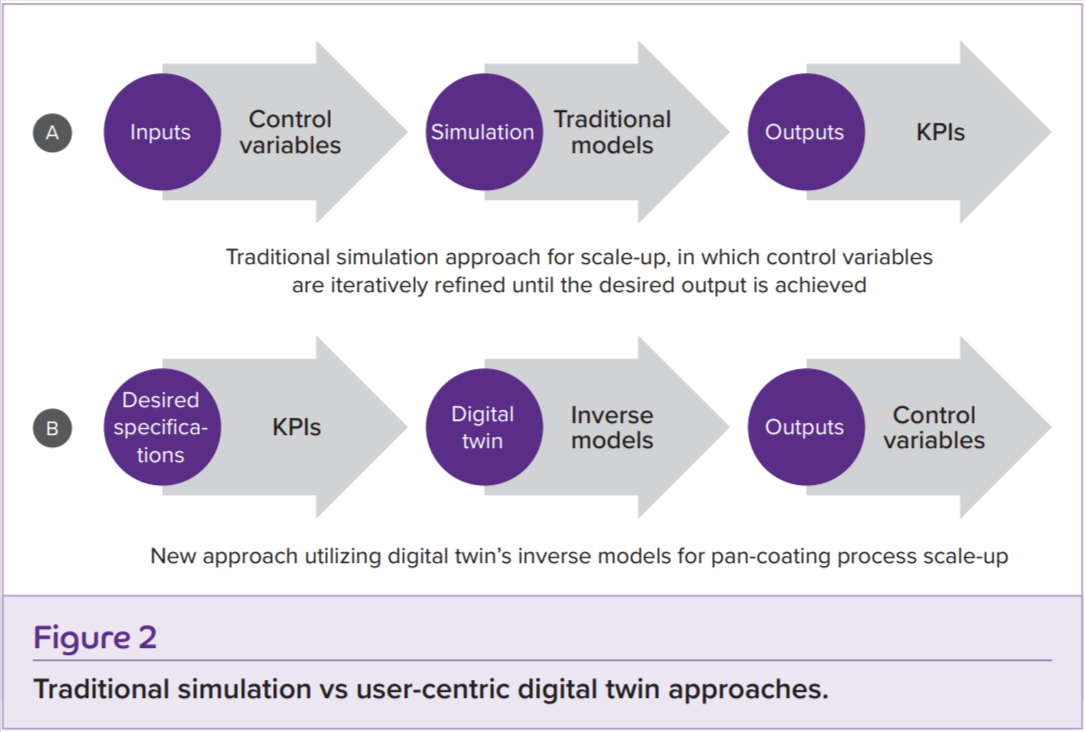
The solution of inverse problems required restructuring mechanistic models to enable collective solution of inverse problems (Figure 2b). The governing equations were reconstituted to give the control variables, such as material properties and operating conditions, as functions of CQAs, including coating weight, film thickness uniformity and coating conditions.
In addition to process details, PCTSUni incorporates operational details such as equipment setup, loading, warmup, cooldown, unloading and changeover. Material, testing and operating expenses are included thereby enabling estimation of plant capacity and cost of goods during basis-of-design and technology selection phases.
The transformation from simulator to an Industry 4.0 digital twin required connecting the analysis and prediction capabilities of the simulator with its physical counterpart. The transformation from Industry 4.0 digital twin to Industry 5.0, or user-centric digital twin, required human input to identify model limitations and to reconstitute equations for addressing inverse problems. The resulting system supports both forward and inverse calculations, allowing users to input KPIs and receive optimized control settings. It also facilitates direct determination of experimental design levels based on the relative influence of each factor.
While PCTSUni has the capability, it does not yet incorporate real-time data and therefore does not meet all criteria of full digital twins. Instead, it is connected at the batch-to-batch level, analyzing variations within manufacturing controls to identify factors that drive differences in product quality and allowing users to adjust model parameters as conditions change over time. While incorporating information from sequential batches is imperfect, the premise of this work is to also showcase the value of human input.
Challenging Assumptions and Revealing Insights
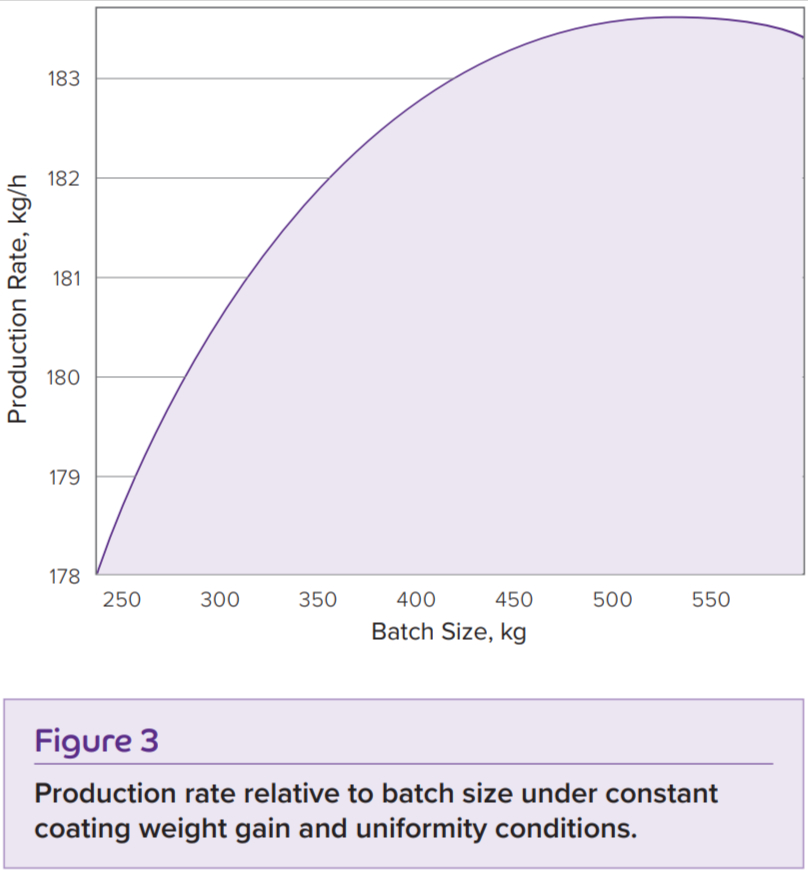
One key insight from PCTSUni was that maximum pan load does not necessarily equate to optimum process capacity or cost efficiency. Initially assumed to be ideal, simulation results (Figure 3) revealed otherwise. The digital twin was updated to determine the optimum pan load, underscoring the value of human-digital interaction in refining assumptions and improving outcomes.
Toward a Streamlined Scale-Up Framework
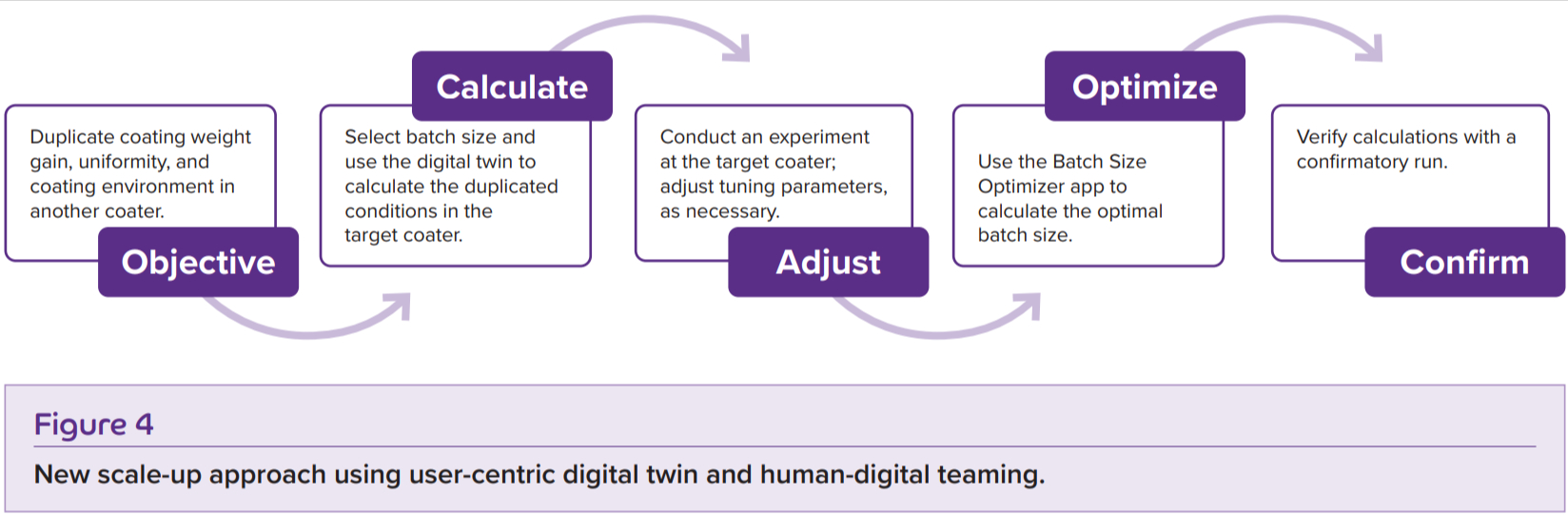
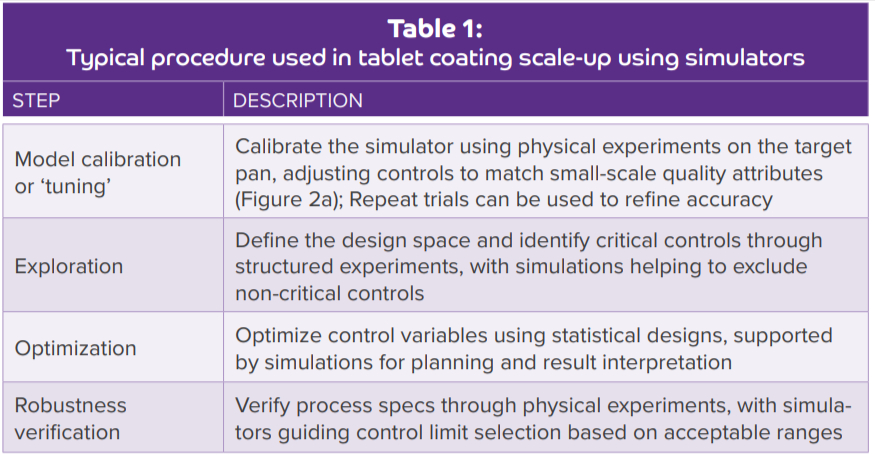
By creating and using digital twins from the outset, we critically evaluated the conventional scale-up framework (Table 1), integrating calibration exploration, and optimization into a cohesive, streamlined procedure. Physical experimentation was limited to essential trials for repeatability and robustness verification (Figure 4).
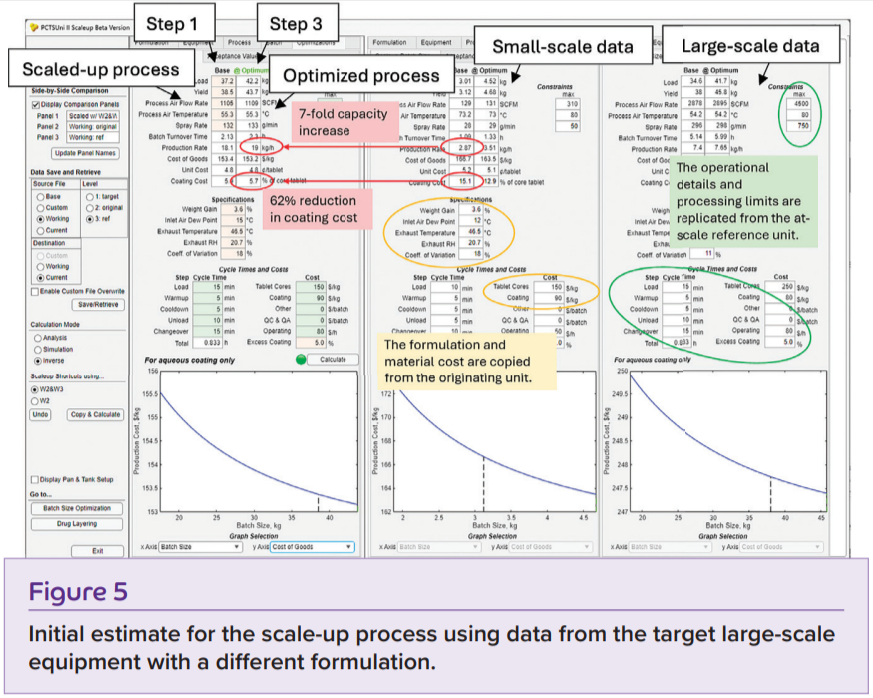
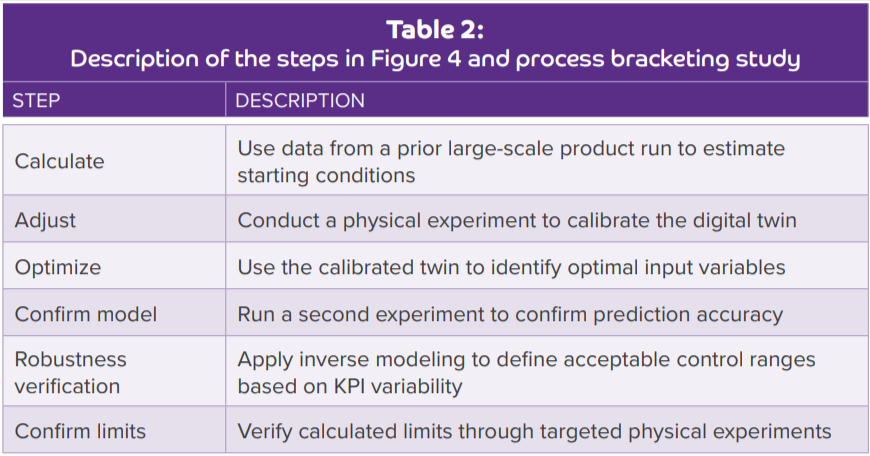
In step 1 of Table 2, PCTSUni’s inverse modeling capabilities enabled integration of small-scale formulation and processing specifications with processing efficiency and operational data from a larger coating unit using a different formulation (Figure 5). Additionally, the twin can directly optimize processes (step 3), potentially bypassing steps 1 and 2 by leveraging improved insights gained from using the digital twin with various formulations and equipment.
The same inverse methodology was applied in step 5 to establish experimental locations for design of experiments (DOE) for robustness verification. By defining acceptable product quality variation, the model calculated corresponding variability specifications for individual or combined control variables.
By creating and using digital twins from the outset, we critically evaluated the conventional scale-up framework (Table 1), integrating calibration exploration, and optimization into a cohesive, streamlined procedure. Physical experimentation was limited to essential trials for repeatability and robustness verification (Figure 4).
In step 1 of Table 2, PCTSUni’s inverse modeling capabilities enabled integration of small-scale formulation and processing specifications with processing efficiency and operational data from a larger coating unit using a different formulation (Figure 5). Additionally, the twin can directly optimize processes (step 3), potentially bypassing steps 1 and 2 by leveraging improved insights gained from using the digital twin with various formulations and equipment.
By creating and using digital twins from the outset, we critically evaluated the conventional scale-up framework (Table 1), integrating calibration exploration, and optimization into a cohesive, streamlined procedure. Physical experimentation was limited to essential trials for repeatability and robustness verification (Figure 4).
In step 1 of Table 2, PCTSUni’s inverse modeling capabilities enabled integration of small-scale formulation and processing specifications with processing efficiency and operational data from a larger coating unit using a different formulation (Figure 5). Additionally, the twin can directly optimize processes (step 3), potentially bypassing steps 1 and 2 by leveraging improved insights gained from using the digital twin with various formulations and equipment.
The same inverse methodology was applied in step 5 to establish experimental locations for design of experiments (DOE) for robustness verification. By defining acceptable product quality variation, the model calculated corresponding variability specifications for individual or combined control variables.
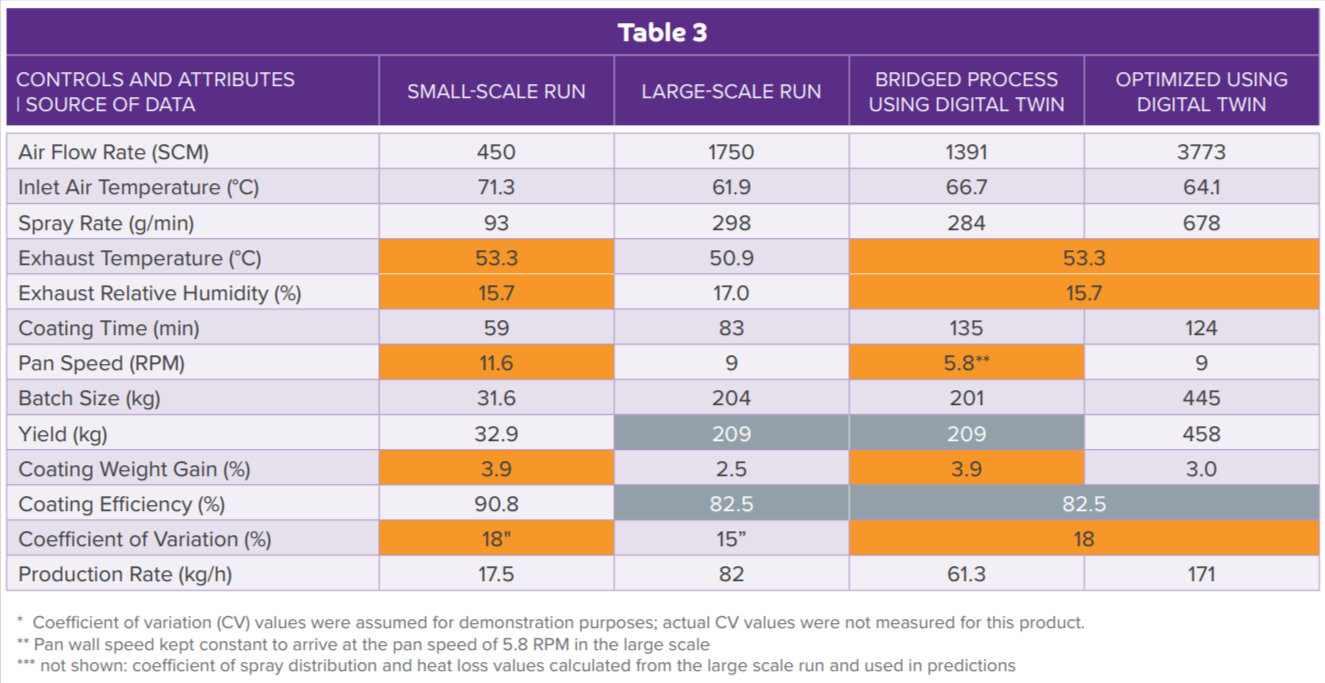
Step 1 in Table 2 is further illustrated through one small-scale and one large-scale experimental runs provided by Lonza Group. The experimental results from these runs were utilized by PCTSUni to predict product- and process-bridged and capacity-optimized conditions at the larger scale, as detailed in Table 3. Formulation parameters and processing conditions from the small-scale run, combined with efficiency and operational factors from the large-scale run, informed the scale-up strategy.
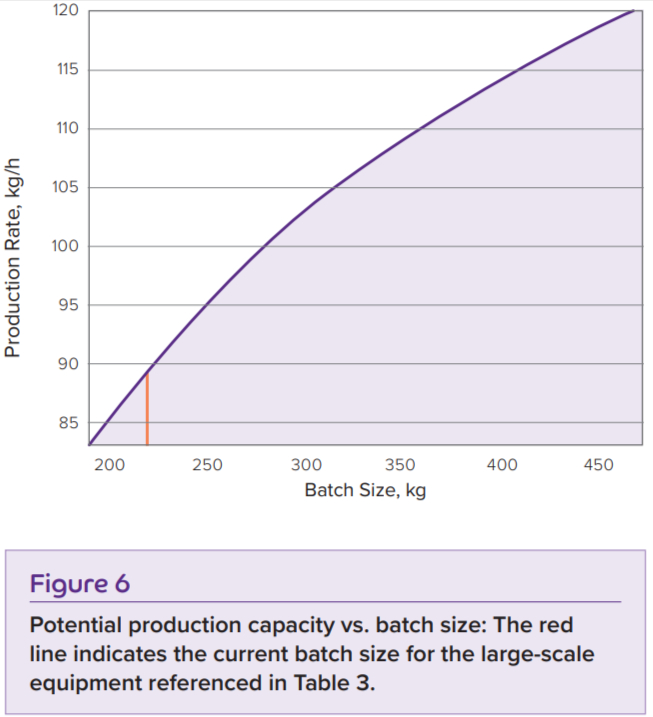
This same dataset was subsequently used to determine the production rate as a function of batch size, as depicted in Figure 6. Final batch size and processing conditions can then be selected using inverse modeling, based on specific production and cost targets.
Beyond Automation: Human–Digital Collaboration
If a traditional simulation approach had been used, repeated iterations would be required to adjust control variables and match product attributes in the large-scale equipment. This process would then have to be repeated to optimize cost or capacity. More importantly, such an approach is poorly suited for human–machine collaboration. Observations like the existence of an optimal batch size would likely be missed — even with automation.
User-centric digital twins, by contrast, enable a collaborative, iterative and insight-driven approach to scale-up. They empower teams to challenge assumptions, streamline experimentation, and design processes that are not only efficient but resilient and adaptable.
Experimental Efficiency and Broader Insights
The user-centric digital twin significantly reduced the need for extensive exploration and optimization experiments. For example, a full-factorial design with five factors at three levels would require 243 experimental runs. While optimization methods can reduce this number, they remain substantial compared with the efficiency of inverse modeling.
PCTSUni delivers optimal conditions directly, allowing users to specify desired outcomes and receive corresponding control parameters. Confirmatory runs remain essential for validation, but the digital twin enables evaluation of a broader set of variables and reveals interaction effects often missed in traditional DOE frameworks (i.e., fractional factorial experiments). As confidence in the model grows, steps such as calibration, optimization and robustness verification may be consolidated — streamlining the development cycle. Nonetheless, some confirmatory and repeat experiments are recommended to assess variability and ensure robustness under real-world conditions.
Digital Twin Capabilities Mature
Using PCTSUni in a case study of tablet coating scale-up, we demonstrated how a simulator can evolve into a user-centric digital twin through targeted enhancements. Originally designed to support decision-making, the simulator lacked the capability to address changing human needs that required both the models and humans to evolve and solve inverse problems. By restructuring mechanistic models and integrating operational and cost data, the digital twin’s utility expanded significantly to directly tackle and address the scale-up problem involving processing, quality, capacity and cost perspectives. Notably, maximizing batch size does not necessarily optimize cost or capacity. Optimization routines were incorporated, enabling users to input KPIs and receive the necessary control parameters to achieve those targets.
The evolution from simulators to user-centric digital twins was also driven by human expertise: identifying inverse problems, reconstituting equations and crafting solutions that redefined the scale-up approach. The resulting system reduced reliance on physical experimentation, streamlined process development and supported tasks such as DOE and troubleshooting through direct inverse modeling.
While this paper focuses on inverse modeling to assist with scale-up, broader inverse modeling techniques are under development.2 As digital twin capabilities continue to mature, they can be expected to play an increasingly central role in process development, technology transfer, and the design and operation of next-generation manufacturing systems.
Acknowledgements
The authors would like to thank Lonza Group AG for providing the data used in Table 3, as well as Gilbert Zayas and Alex Rastelli for their valuable experimental insights.
References
- Gallagher, N. and Armstrong, M. (2025, Oct). “What is a Digital Twin?” IBM.
- Kiviat, P. (1967, Aug). Digital Computer Simulation: Modeling Concepts. RAND Corporation.
- McGraw-Hill Dictionary of Scientific & Technical Terms. (2003). The McGraw-Hill Companies. [accessed July 24, 2025]
- “Computer Simulation.” Wikipedia. [accessed July 24, 2025]
- Shamim, N. et. al. (2017, Nov). Real-Time Digital Simulators: A Comprehensive Study on System Overview, Application, and Importance. Int Journal of Research and Engineering. 4 (11), 2348-7852.
- Foundational Research Gaps and Future Directions for Digital Twins. (2024). National Academies of Sciences, Engineering, and Medicine.
- Noel Crespi, N. et. al. (2023, June). The Digital Twin: What and Why? Springer, Chapter 1.
- “Digital Twin.” Wikipedia. [accessed July 24, 2025]
- Boreham, J. (2024, June). Digital Twin vs. Simulation: Understand the Key Differences. Digital Twin Insider.
- Choi, M. (2021). Novel Coating Uniformity Models for Tablet Pan Coaters. AAPS PharmSciTech. 22(7).
- Choi, M. (2021). Interrelationships between Coating Uniformity and Efficiency in Pan Coating Processes. AAPS PharmSciTech. 22(265).
- Choi, M. et. al. (2022). Application of Mathematical Models to Determine the Feasibility of Amorphous Drug Layering in Pan Coaters. Pharmaceutics. 14(149).
- Choi, M., et. al. (2022, Oct). Managing Uncertainty: Mathematical Modelling Can Guide Key Tablet Coating Decisions. Tablets & Capsules.
- Choi, M. et. al. (2023, Oct). Cosmetic Coating: Saving Money by Employing a ‘Digital Twin. Tablets & Capsules.
- Landman, M., et. al. (2024). A Joint Reconstruction and Model Selection Approach for Large Scale Inverse Modeling. Geosci Model Dev.17 (23), 8853–8872.